All species › Gannets and cormorants › Cormorants and shags › Little Black Cormorant
Little Black Cormorant | Phalacrocorax sulcirostris
Zwarte aalscholver | Cormorán totinegro
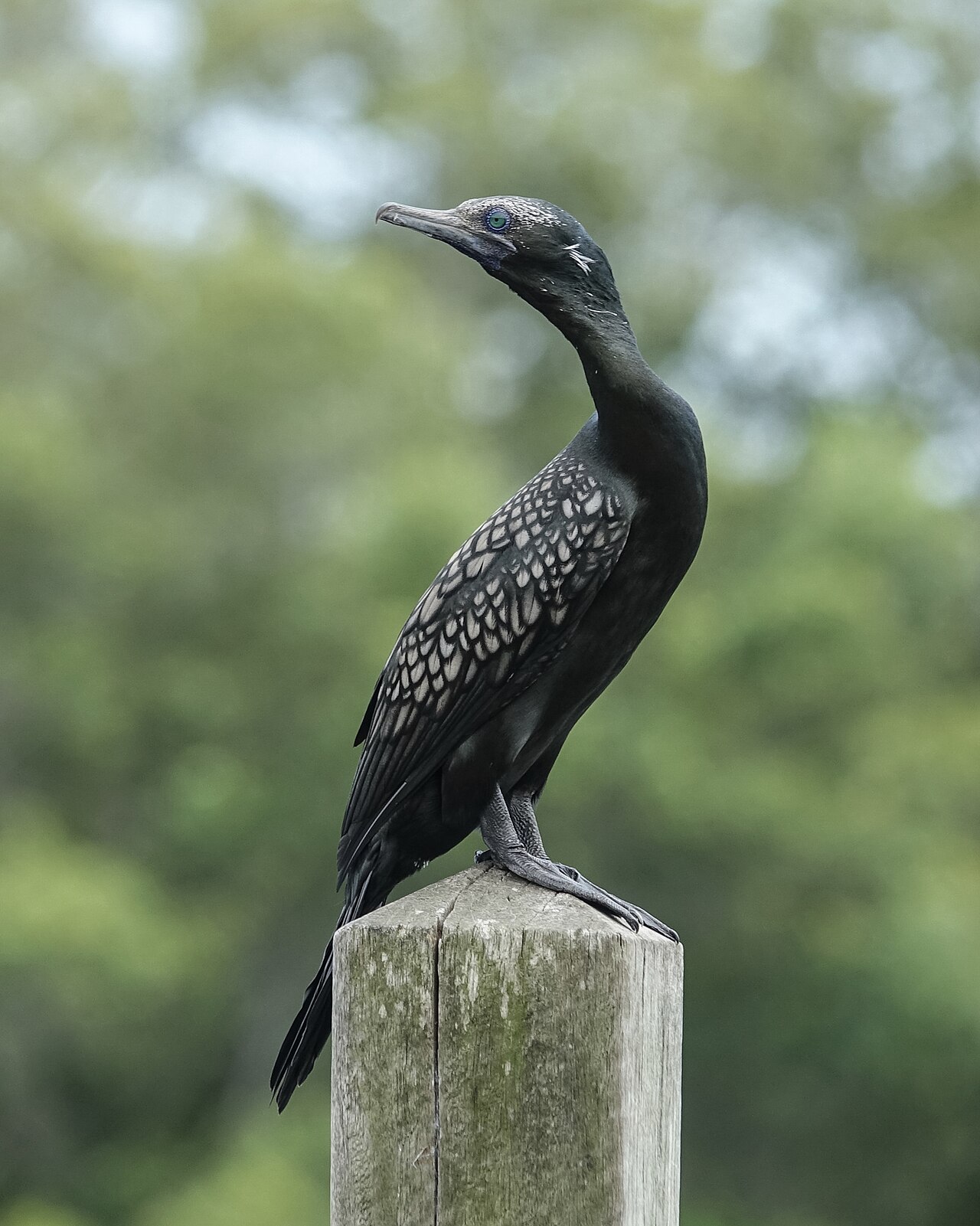
The Little Black Cormorant is the slim, wholly black cormorant of inland water: smaller and leaner than the Great Cormorant, with a thin grey bill and not a trace of yellow or white at the throat. It is the only cormorant here that fishes in large co-ordinated flocks and that flies over in V-formation.
Voice
On the water and away from the colony it is silent for most of the year. At the breeding colony the male gives throaty croaks and whistled notes: a dull rolling korr-korr-korr in display, and short clipped bursts when changing over at the nest. The female stays largely mute. Chicks beg with a shrill, persistent squeal that carries over the colony noise.
Recording: Marc Anderson — CC BY-NC-SA 3.0 · Royal National Park, New South Wales, Australia · xeno-canto
Identification
A slender cormorant of a little over sixty centimetres, wholly black with a green gloss across the back, where fine dark feather edges give the plumage a faintly scaled look. The bill is thin, grey and hooked, the facial skin dark, the legs and feet black. At close range the iris is the best feature: bright green, noticeably greener than in any other cormorant of the region. In breeding condition fine white flecks appear on head and neck. Young birds are duller brown-black with a yellowish bill. In flight it looks long and straight, thin-necked and fast-beating, often in a V or a long line.
Confusion species
Great Cormorant (Phalacrocorax carbo) is much bigger and heavier, with a yellow throat patch, a white chin and a white thigh patch when breeding — three features the Little Black never shows — and its bill is heavy rather than thin. Little Pied Cormorant (Microcarbo melanoleucos) has a short thick yellow bill and a proportionally longer tail, and in New Zealand an all-black form occurs that cannot be separated on the body at all: look only at the bill. Black-faced Cormorant (Phalacrocorax fuscescens) and Spotted Shag (Phalacrocorax punctatus) are coastal birds with white or pale grey underparts. Australian Pied Cormorant (Phalacrocorax varius) is pied and large.
Habitat
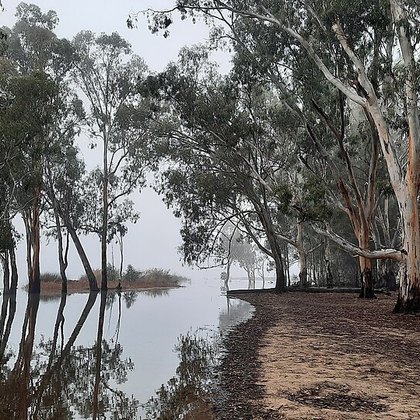
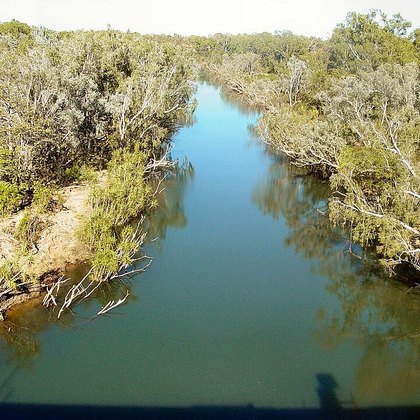
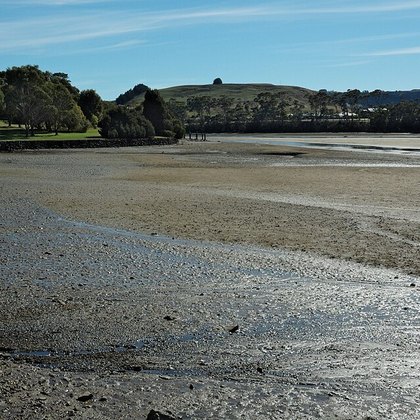
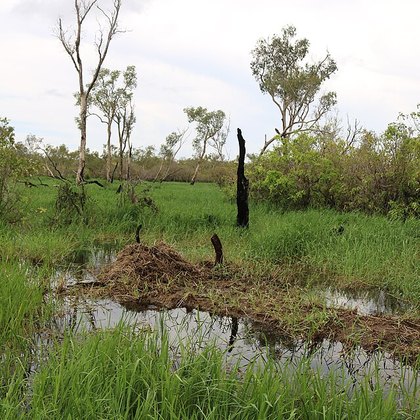
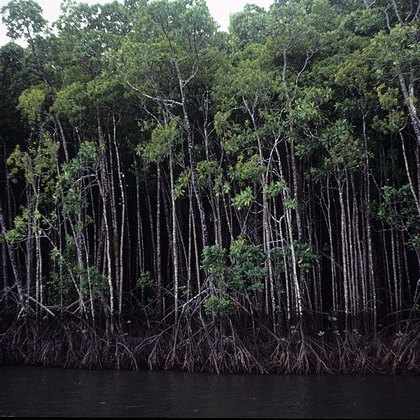
Mainly fresh and deep inland water: lakes, reservoirs, slow rivers and creeks, farm dams, irrigation channels and swamps with open water. It avoids the shallowest margins and prefers to hunt with a group over a school of fish rather than alone along a bank. On the coast it uses sheltered bays, harbours, estuaries and locally mangrove. To dry off it needs a post, a jetty, a dead tree or a rock.
Where the bird is most often found, arranged by main group and formation.
Range and movements
Across nearly all of Australia including Tasmania, bar the western deserts, and on to Norfolk Island and Lord Howe. In New Zealand it is chiefly a North Island bird — Northland, Rotorua, Taupo, the Wairarapa and Wellington — but records from the South Island are increasing; it arrived relatively recently and is still spreading. In inland Australia it shifts with the filling and drying of rivers and claypans (shallow clay basin that holds water for a time after rain), gathering in large numbers wherever water stands.
- Resident
- dark = core range, pale = thinly spread
Where and when to look
Look for a flock that moves over the water as one body and dives together again and again: no other cormorant here does that. On a lone black bird at close range check the eye — bright green settles it at once. Groups flying over a lake or reservoir in a V or a long line are almost always this species.
Conservation
Least Concern (LC), common and widespread, and in Australia helped along by reservoirs, farm dams and irrigation works. In New Zealand it is listed nationally as Naturally Uncommon, with probably several thousand birds and a slowly rising trend. The biggest single loss is drowning in unattended set nets and fyke nets, which can take a whole fishing flock at once; beyond that count disturbance at colonies and the loss of old waterside trees used for nesting.
Scientific name
Phalacrocorax sulcirostris | (Brandt, 1837)
Brandt described the species in 1837 as Carbo sulcirostris; because it later moved to Phalacrocorax, author and year stand in parentheses. The genus Phalacrocorax goes back to Brisson (1760) and is the Latin name for the cormorant, from Greek phalakros, 'bald', and korax, 'raven'. sulcirostris means 'grooved-billed', from Latin sulcus, 'furrow', and rostrum, 'bill'. The type locality is given as 'Terres australes'; Mathews restricted it in 1912 to New South Wales.