All species › Passerines › Thornbills, scrubwrens, gerygones and allies › Large-billed Scrubwren
Large-billed Scrubwren | Sericornis magnirostra
Nachtegaalstruiksluiper | Sedosito picudo
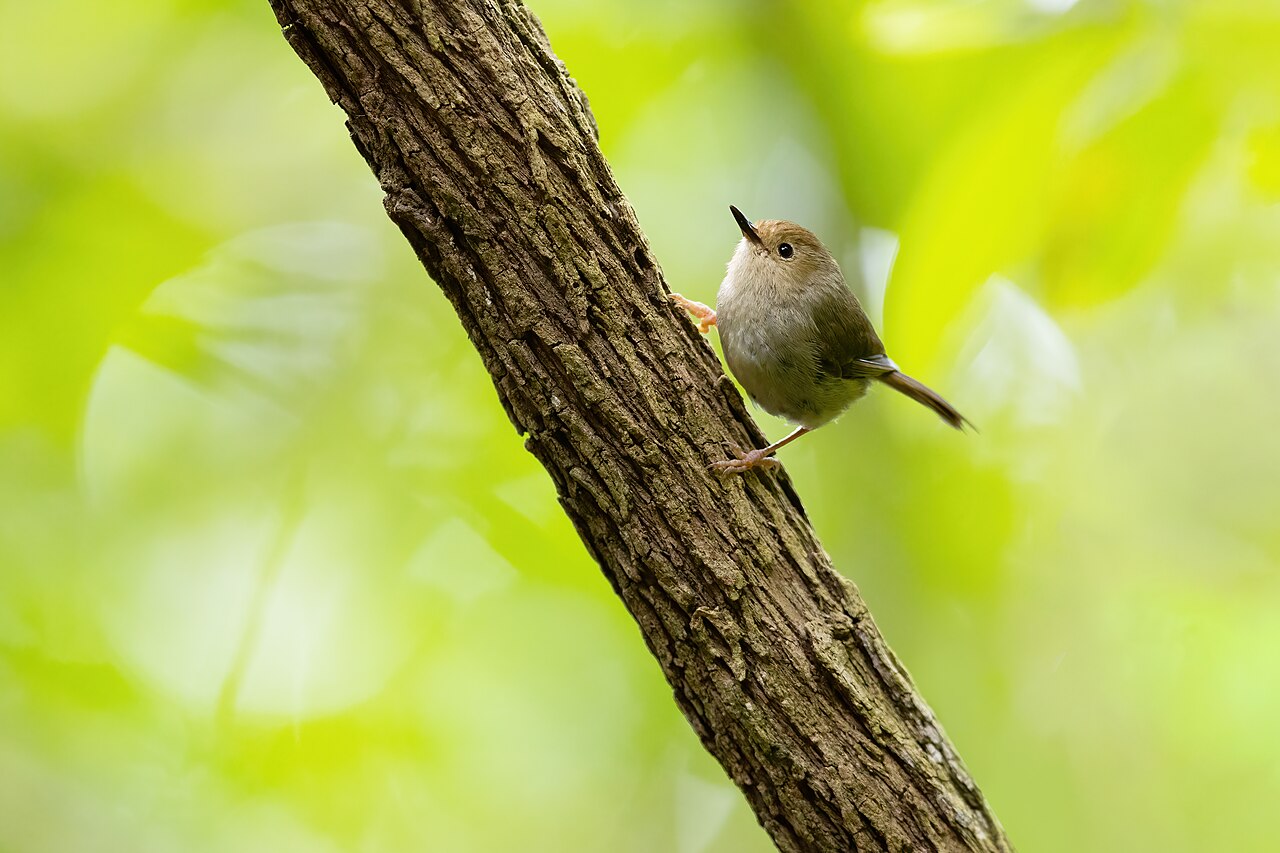
The Large-billed Scrubwren is the scrubwren that does not stay on the ground: it works the lower and middle branches, hangs upside down from trapped leaf litter and climbs through vines, so that in rainforest it is often the first scrubwren you hear above your head rather than under your feet. It is a small, featureless brown bird with a strikingly long, slightly upturned bill.
Voice
Mostly quiet, but while feeding it gives a sharp, loud twittering and a series of hard notes that carry well for so small a bird. There is also a penetrating territorial call. The whole is busier and higher than the grating notes of the Atherton Scrubwren (Sericornis keri), with which it shares the mountain forests of the Wet Tropics, and that difference is usable in the field.
Recording: James Lambert — CC BY-NC-SA 4.0 · Aspley, Brisbane City, Queensland, Australia · xeno-canto
Identification
Eleven and a half to thirteen centimetres, ten grams. The face is pale buff and entirely plain: no eyebrow, no mask, no spot. The eye is dark reddish brown and sits in that pale face. The bill is long, black and angled slightly upward — at a distance that outline is the best feature. The upperparts are light grey-brown washed olive, the throat buffy white, the belly greyish, and rump and tail run to light rufous. The sexes are alike.
Confusion species
White-browed Scrubwren (Sericornis frontalis) is the commonest alternative in the south-east, but has a broad white eyebrow above and below the eye, a pale cream iris and a dark face — exactly the pattern this species entirely lacks — and it keeps close to the ground. Atherton Scrubwren (Sericornis keri) is darker, slightly larger and forages on the floor; a scrubwren seen high in vines in Queensland upland rainforest is this one. Yellow-throated Scrubwren (Neosericornis citreogularis) is large, with a yellow throat and a black mask. Brown Thornbill (Acanthiza pusilla) has a short bill, a scalloped forehead and a pale iris. A plain dull-brown bird with a long bill working upside down at hanging litter is this species.
Habitat
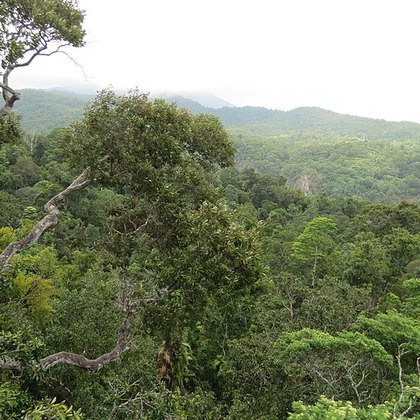
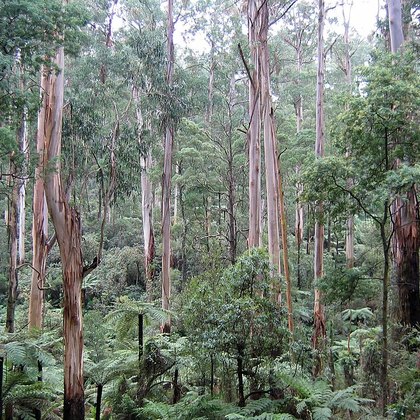
Rainforest in the tropics and wet sclerophyll forest in temperate country, always where the undergrowth is dense and vines, epiphytes and trapped dead leaves hang in the branches — that trapped litter is its real hunting ground. It forages in the lower and middle storeys, usually in small parties, gleaning spiders, ants, wasps and beetle larvae from bark and leaves. Notable is its habit of taking over the abandoned nests of other species, above all those of Yellow-throated Scrubwren (Neosericornis citreogularis), rather than building from scratch.
Where the bird is most often found, arranged by main group and formation.
Range and movements
Eastern Australia, from near Cooktown in northern Queensland south along the coastal ranges to the Dandenong Ranges near Melbourne. Three subspecies occupy sections separated by dry country, so the range is not continuous. It is sedentary and does not migrate, but wanders within the forest in mixed parties. In suitable forest it is common and in many places the most numerous scrubwren above ground level.
- Resident
- dark = core range, pale = thinly spread
Where and when to look
Look up, not down. At Lamington, Dorrigo, the Illawarra or the Dandenongs the standard trick is this: find a clump of dead leaves caught in vines or between branches, and wait. This species works such clumps systematically, often hanging upside down, and stays with them a long time. Parties are noisy while feeding; follow the twittering by ear and then find the height it comes from — usually three to eight metres, which by itself rules out most other scrubwrens.
Conservation
Least Concern (LC). The range is extensive, numbers are stable, and the species persists in forest remnants and disturbed forest as long as the vine and litter layer stays intact. The concerns are local: clearing of coastal rainforest, tidying of understorey that removes the hanging dead leaves, and fire reaching into the wet gullies. No national decline has been established.
Scientific name
Sericornis magnirostra | (Gould, 1838)
Gould described the bird in 1838; because it was later placed in another genus, author and year stand in parentheses. Sericornis is formed from Greek serikos (silken) and ornis (bird). The specific name magnirostra is Latin for 'great bill', which is exactly what the English name says. The Dutch name refers instead to the voice. The type locality is Sydney.