All species › Passerines › Fairywrens, grasswrens and emu-wrens › Kalkadoon Grasswren
Kalkadoon Grasswren | Amytornis ballarae
Kalkadoongrassluiper | Maluro kalkadoon
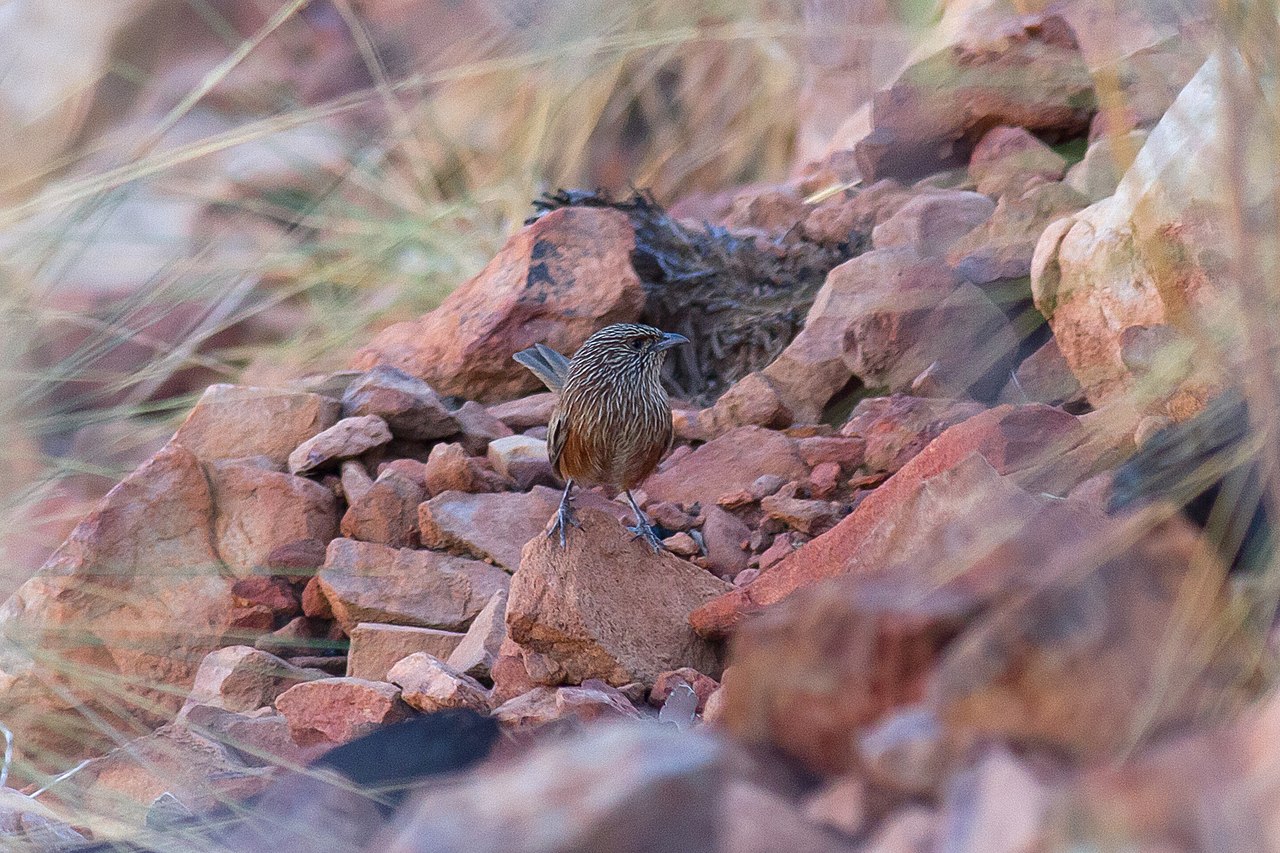
The Kalkadoon Grasswren is the grasswren of the Selwyn Range near Mount Isa in north-western Queensland, and it occurs nowhere else. It is a recent split: Condon described it in 1969 as a subspecies and only much later was it accepted as a species of its own, once plumage, measurements and relationship studies separated it from its nearest relatives. Its range is among the smallest of all grasswrens.
Voice
A high, thin, rapidly reeling song of a few seconds, sung from a spinifex (spiny, hummock-forming desert grass of the interior) hummock or a boulder on the slope. The contact call is a fine, sharp tsip; in alarm dry chek notes as the birds run off between the stones. The sound is pitched high and is easily missed in the hot, shimmering air above the rocky slopes. In this country, where the bird is thinly spread, the song is usually the first and often the only sign.
Recording: JACOB Hervé — CC BY-SA 4.0 · Townview, Mount Isa City, Queensland, Australia · xeno-canto
Identification
Fifteen to sixteen centimetres, of which the tail is about half; the tail is short for a grasswren and is held up when the bird runs. The plumage is dark reddish brown with fine, vague white shaft streaks on crown, mantle and breast — clearly less sharply marked than in the striatus group. The throat is greyish white and not sharply set off, and a heavy black moustachial stripe is absent. The female has rufous flanks. The bill is fine and dark, the legs long.
Confusion species
From Dusky Grasswren (Amytornis purnelli) this species honestly cannot be told in the field: both are dark, faintly streaked and short-tailed, and the only practical criterion is range — purnelli is in the Central Ranges, a good thousand kilometres to the south-west. Measurements do show a slightly shorter tail, but that difference is of no use through binoculars. Carpentarian Grasswren (Amytornis dorotheae) is the species that does come near: its range approaches this bird's in north-western Queensland, but it is a distinctly brighter chestnut, far more sharply streaked, and carries a clean white throat with a heavy black moustachial stripe. Short-tailed Grasswren (Amytornis merrotsyi) likewise has a short tail but is in South Australia and does have that sharp throat pattern.
Habitat
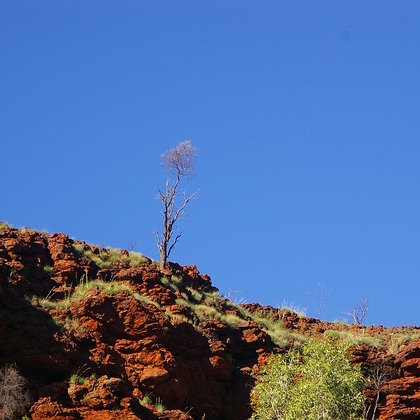
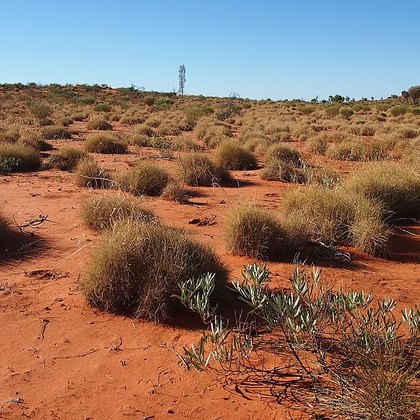
Old, dense spinifex hummocks (Triodia) on steep, scree-covered slopes and rocky ridges of the Selwyn Range and neighbouring ranges, often on the broken quartzite and slate slopes that mark this mining country. As with all grasswrens fire history decides everything: it needs hummocks that have gone many years without burning. The rocky relief supplies shade and sheltering crevices and checks the fire. It forages on foot over the bare ground between the hummocks and hardly flies.
Where the bird is most often found, arranged by main group and formation.
Range and movements
Only north-western Queensland: the Selwyn Range and the surrounding rocky ridges between roughly Mount Isa, Cloncurry and Dajarra. The type specimen comes from a spot just south of Mary Kathleen. The occupied area is small and, moreover, fragmented over separate slopes and ridges; the birds hardly cross the plains between them. It is sedentary and does not move.
- Resident
- dark = core range, pale = thinly spread
Where and when to look
Along the roads near Mount Isa, find a steep scree slope where the spinifex hummocks stand knee-high, closed and visibly old, and sit there in the first hour after sunrise. A slope that has burnt in recent years can be skipped. Stand still at the first thin tsip and let the birds come to you; flushing them yields only a running shape among the stones. Anyone wanting to name the species need not hesitate in this area: a dark, faintly streaked grasswren on rock is this bird here.
Conservation
Vulnerable (VU). The reason is the combination of a very small range and a fire regime that can empty that range for years in a single season: large, hot fires remove the old spinifex hummocks, and the surviving birds are then too far apart to recolonise the bare slopes. Grazing thins the hummocks further, and feral cats hunt freshly burnt ground with particular efficiency. The Selwyn Range is mining country besides, so whole ridges can locally be cut away. Management turns on small-scale, cool burning.
Scientific name
Amytornis ballarae | Condon, 1969
Herbert Condon described the bird in 1969 as Amytornis textilis ballarae, from a specimen taken a few kilometres south of Mary Kathleen in north-western Queensland; it was then for a time placed with the Dusky Grasswren (Amytornis purnelli), and only later accepted as a species of its own. The genus was first called Amytis, after a Persian princess; as that name was preoccupied, Leonhard Stejneger proposed Amytornis in 1885, with Greek ornis (bird). The English name, like the Dutch, cites the Kalkadoon or Kalkatungu, the Aboriginal people of the country around Mount Isa in which the species lives.