All species › Passerines › Thornbills, scrubwrens, gerygones and allies › Inland Thornbill
Inland Thornbill | Acanthiza apicalis
Roodstuitdoornsnavel | Acantiza apical
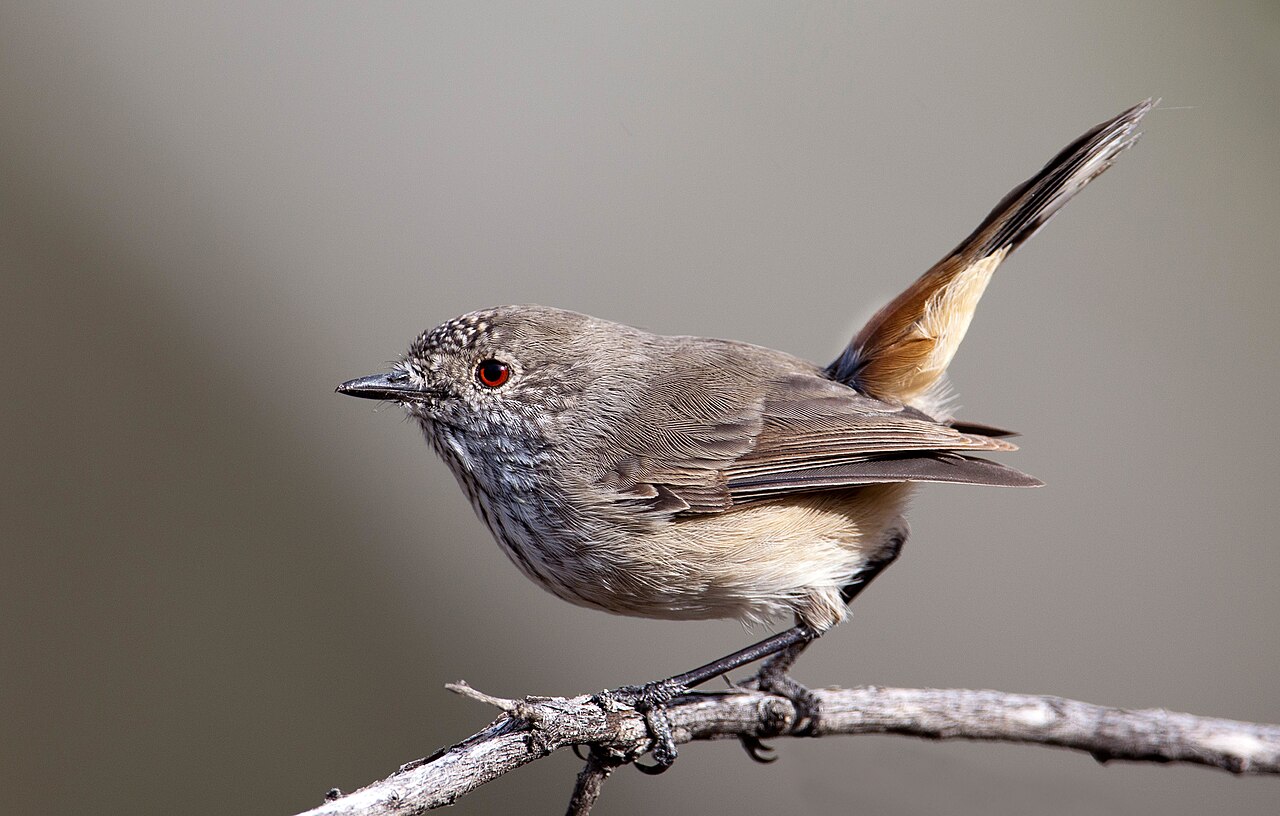
The Inland Thornbill is the most widespread thornbill of the dry interior and at the same time the most restless: a bird that holds its long tail cocked almost continually, with a rufous rump, a deep red iris and a throat full of dark streaks. It is also a mimic, producing the sounds of other species in a quiet stand of mulga (acacia scrub of the dry interior, dominated by Acacia aneura).
Voice
A spirited, forceful territorial song that carries remarkably far for a bird of ten centimetres, and high contact notes of the tsee-tsee type. The species is a gifted mimic and takes up, among others, the notes of Pied Butcherbird (Cracticus nigrogularis), Rufous Whistler (Pachycephala rufiventris) and several cuckoos. Anyone hearing an odd sequence in the mulga that does not fit the local birds would do well to look for a thornbill first.
Recording: Greg McLachlan — CC BY-NC-SA 4.0 · Euabalong, Cobar Shire Council, New South Wales, Australia · xeno-canto
Identification
Nine to eleven centimetres, grey-brown above, with a black-and-white scalloped forehead, a bright rufous rump and a tail with a broad dark band and white tips — that last character supplied the scientific epithet. The iris is deep red. The throat and breast carry clear dark streaking, and the tail is proportionally long and often held up. Males are slightly larger than females, but the sexes are otherwise alike. Four subspecies are recognised, among them the nominate in south-western Western Australia and albiventris in the east of the range.
Confusion species
This is the hinge of the inland thornbill problem and there are four counterparts. Brown Thornbill (Acanthiza pusilla) is the closest and overlaps along the Great Dividing Range: it has a shorter tail that is not cocked, less breast streaking and a warmer rufous tone. Chestnut-rumped Thornbill (Acanthiza uropygialis) has a white rather than red iris, a paler grey-brown back and no streaking below. Slaty-backed Thornbill (Acanthiza robustirostris) shares the red iris but has a slate-grey back and an entirely unstreaked creamy-white underside. In the south-west the counterpart is Western Thornbill (Acanthiza inornata): plain, pale-eyed and without a coloured rump. Tasmanian Thornbill (Acanthiza ewingii) is similar too and has white undertail coverts, but occurs only in Tasmania and the Bass Strait islands and so does not overlap.
Habitat
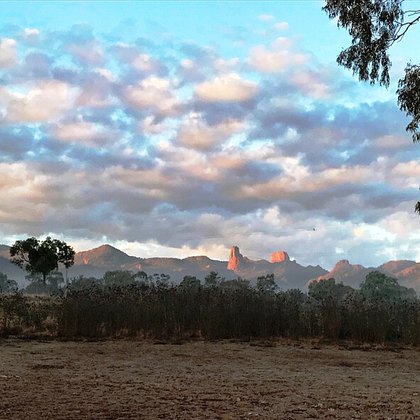
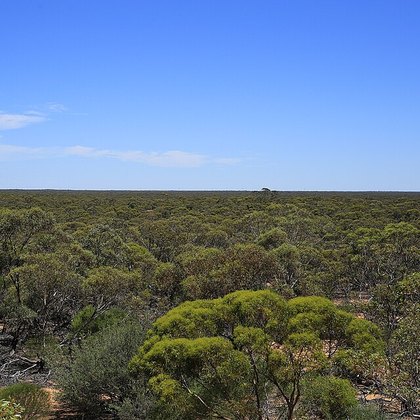
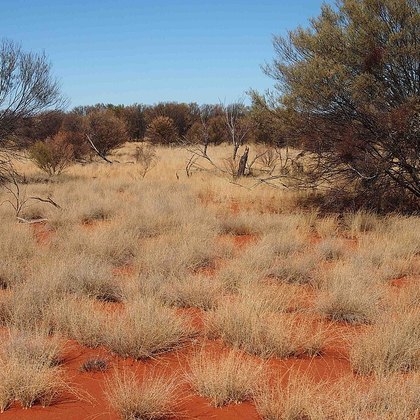
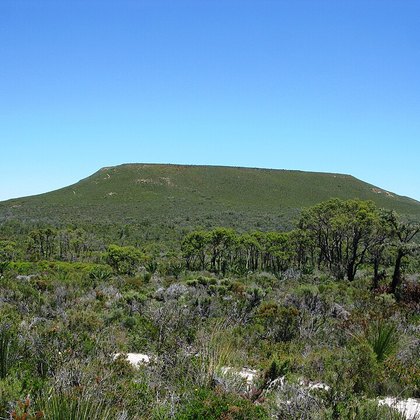
Despite the English name, a species of varied habitats: dry woodland and acacia scrub across almost all of inland Australia, mallee (low, multi-stemmed eucalypt scrub of dry southern Australia), callitris woodland, and in the south-west also sandplain heath, dense karri forest and even coastal mangrove. The common factor everywhere is a dense shrub layer. It forages in foliage and understorey for spiders and small insects, usually in pairs or small parties, and comes to the ground less often than Yellow-rumped Thornbill. The nest is a small dome of bark strips and grasses bound with spider web and with a hooded entrance hole, low in a shrub.
Where the bird is most often found, arranged by main group and formation.
Range and movements
Widespread across inland Australia: from north-western Victoria, western New South Wales and Queensland through the centre of the Northern Territory and Western Australia south of the Tropic of Capricorn, and through South Australia except the south-east. In the south-west it reaches the coast. It is sedentary, locally nomadic. It does not occur in New Zealand.
- Resident
- dark = core range, pale = thinly spread
Where and when to look
The tail is your first clue, before any colour: a thornbill that holds its tail up and flicks it constantly is, in the interior, all but certainly this species. Confirm with the streaked throat and the red eye. A bird that responds strongly to imitated alarm notes and starts mimicking in reply points the same way. In the south-west the choice is simpler: only this species and Western Thornbill are brown thornbills there, and only this one has a rufous rump.
Conservation
Least Concern (LC) and rated secure in every state where it occurs. The species is common and versatile enough to hold on across widely differing vegetation, from mangrove to desert scrub. It does decline where the shrub layer goes through overgrazing, too-frequent fire or the clearing of woodland, since dense understorey is the condition all its habitats share.
Scientific name
Acanthiza apicalis | Gould, 1847
John Gould described the species in 1847 in The Birds of Australia. The epithet apicalis is Latin for 'of the tip' and points to the white tips of the tail feathers. The Noongar people of south-western Western Australia call the bird Djoobi-Djoolbang. The English name Inland Thornbill takes the centre of gravity of the range, though it does less than justice to the south-western coastal and mangrove populations. The Dutch roodstuitdoornsnavel and the Spanish acantiza apical each take a different character: the rump and, as the scientific epithet does, the tail tips.