All species › Passerines › Crows, jays and magpies › House Crow
House Crow | Corvus splendens
Huiskraai | Cuervo casero
The House Crow is the only bird in this guide that never reached Australia under its own power: it comes from southern Asia and travels aboard cargo ships. In the ports of Fremantle, Darwin and Brisbane it turns up every few years and is shot every time, because nobody wants an established population. It stands here not as an Australian bird but as a warning.
Voice
A flat, dry kaaw-kaaw, higher and shorter than the calling of the Australian ravens and without the long dying final note that marks the Australian Raven. The notes come in series of two to four, often from a mast, a crane or a roof edge. There is also a sharper, plaintive kwaa when the bird is uneasy, and soft chattering in the communal roost trees, where hundreds gather in the native range. Anyone with the calls of Australian corvids in the ear hears at once that this is something else: shorter, flatter, less mournful.
Recording: David Darrell-Lambert — CC BY-NC-SA 4.0 · Jumeirah Village Triangle, Dubai, United Arab Emirates · xeno-canto
Identification
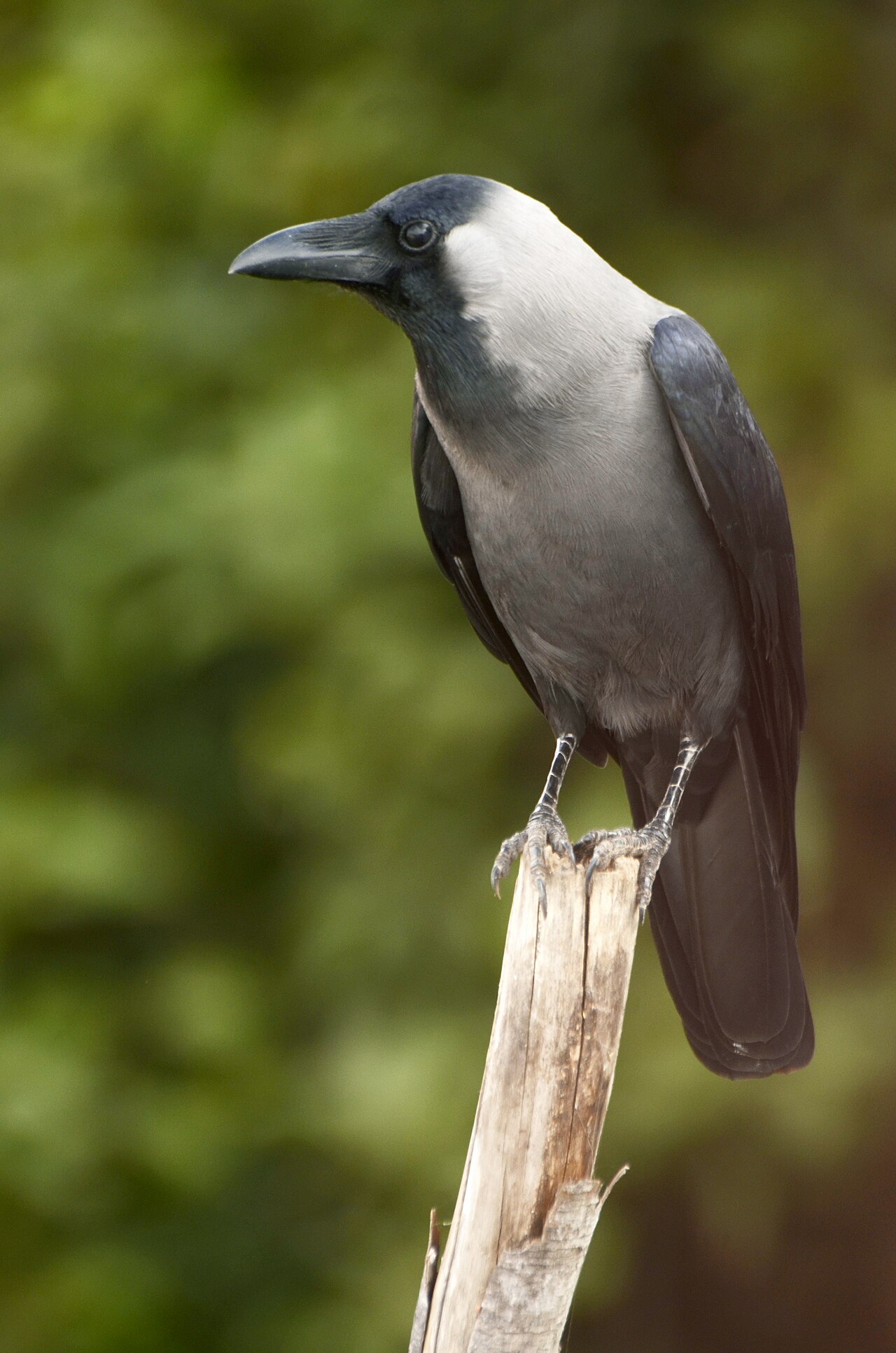
Forty centimetres: small and slim for a crow, with a long bill arched along the upper edge and a fairly long tail. The head is deep glossy black on forehead, crown, throat and upper breast, but the nape, neck and lower breast are dull grey-brown, so that the bird appears to wear a pale collar. Wings, tail and legs are black. The iris is dark brown — the mark that settles the matter at once in Australia, because every adult Australian crow and raven has a white eye. The long throat hackles that puff out when Australian ravens call are entirely absent.
Confusion species
In an Australian port the question is not which crow this is, but whether it is an Australian one at all. The Torresian Crow (Corvus orru), the Australian Raven (Corvus coronoides) and the Little Raven (Corvus mellori) are all larger, wholly black without a grey collar, and white-eyed as adults; Little Crow (Corvus bennetti) of the interior is the smallest native species but likewise lacks the grey collar. The grey-brown neck and breast together with the dark eye are decisive and visible at tens of metres. The Rook (Corvus frugilegus), the other introduced corvid in this guide, does have a dark eye but is wholly black with a bare pale bill base and keeps to New Zealand farmland, not to ports. Young Australian Ravens have a dark iris and are the one real pitfall: then look at the collar, which they do not have.
Habitat
Entirely man-made landscape. In the native range this is the village street, the market, the yard and the rubbish tip; on arrival in Australia it is the wharf, the container yard, the shed and the trees on the harbour square. The species needs people, waste and a few trees — nothing more. Natural vegetation without human presence is avoided, which is exactly why it can settle so fast in a port city.
Where the bird is most often found, arranged by main group and formation.



Range and movements
Originally southern Asia: Iran, Pakistan, Nepal, India, Bangladesh, Sri Lanka, the Maldives, Myanmar and Thailand. From there shipping has carried it across half the world, with established or temporary populations in East Africa, along the Red Sea, on the Arabian Peninsula, in Malaysia, Singapore, Hong Kong, the Netherlands, Ireland and Florida. In Australia it is a regular stowaway: birds arrive aboard ships at port cities, Fremantle in Western Australia being the best known, and also Darwin, Melbourne, Sydney, Brisbane and Cairns. There is so far no self-sustaining Australian population; every attempt at establishment has been broken off because the birds were found and killed. Resident in everything it does: it does not migrate, it sails.
- Resident
- Passage
- dark = core range, pale = thinly spread
Where and when to look
Do not look for it in the field but on the wharf. With any corvid in or around a large Australian port, look twice at neck and eye: a grey-brown collar and a dark iris mean this is not an Australian bird. Photograph it if at all possible and report it at once to the state agriculture or biosecurity service — with this species every day counts, because a pair that starts breeding is far harder to remove than a single arrival.
Conservation
Globally the species is of Least Concern (LC); in its native range it is common and increasing. In Australia the question is reversed: here the House Crow counts as an invasive alien and is a declared pest under law. The objection is threefold: it robs the nests of smaller native songbirds, it displaces other birds from urban food sources, and it poses a risk to agriculture and public health. Western Australia has run a detection and destruction programme in its ports for decades, and it has worked: there is still no established Australian population. On Socotra in Yemen the species was wholly eradicated in 2009, which shows that early action pays. This is therefore the rare species page on which 'conservation' means the opposite.
Scientific name
Corvus splendens | Vieillot, 1817
Louis Pierre Vieillot described the bird in 1817 as Corvus splendens, and it still stands in that genus, so author and year remain without parentheses. Corvus is the ordinary Latin word for raven. The epithet splendens is Latin for 'shining, glittering', after the strong blue-black gloss on head and throat. The type locality is Bengal. Four subspecies are recognised, differing mainly in the heaviness of the bill and in how pale the grey collar is. The Dutch name 'huiskraai' translates the English House Crow and says exactly what matters: a crow that belongs to the house.