All species › Passerines › Honeyeaters › Grey-headed Honeyeater
Grey-headed Honeyeater | Ptilotula keartlandi
Grijskophoningeter | Mielero cabecigrís
The Grey-headed Honeyeater is the honeyeater of the rocky gorges and stony ridges of dry Australia. Where the other members of the genus sit in woodland or scrub on sand, this species keeps to rock faces, spinifex (spiny, hummock-forming desert grass of the interior) slopes and the flowering hakeas and grevilleas standing on the gorge floors. That makes it the best-placed of the group: anyone in the Pilbara or the central ranges who sees a small honeyeater with a grey crown and a bright yellow ear streak usually need not hesitate for long.
Voice
The contact call is a persistent, rather peevish chip, given almost without a break as the bird works through foliage. The song is a series of rolling, chirruping whistles often written as wee-wee-wee, interspersed with a single loud, harsh squawk and short, high yelping notes. In a gorge with hard walls that sound echoes and the bird seems closer than it is. At a waterhole in early morning dozens of birds may call at once, which carries far across the otherwise silent interior.
Recording: John Graff — CC BY-NC-SA 4.0 · Turee Creek Station, Western Australia, Australia · xeno-canto
Identification
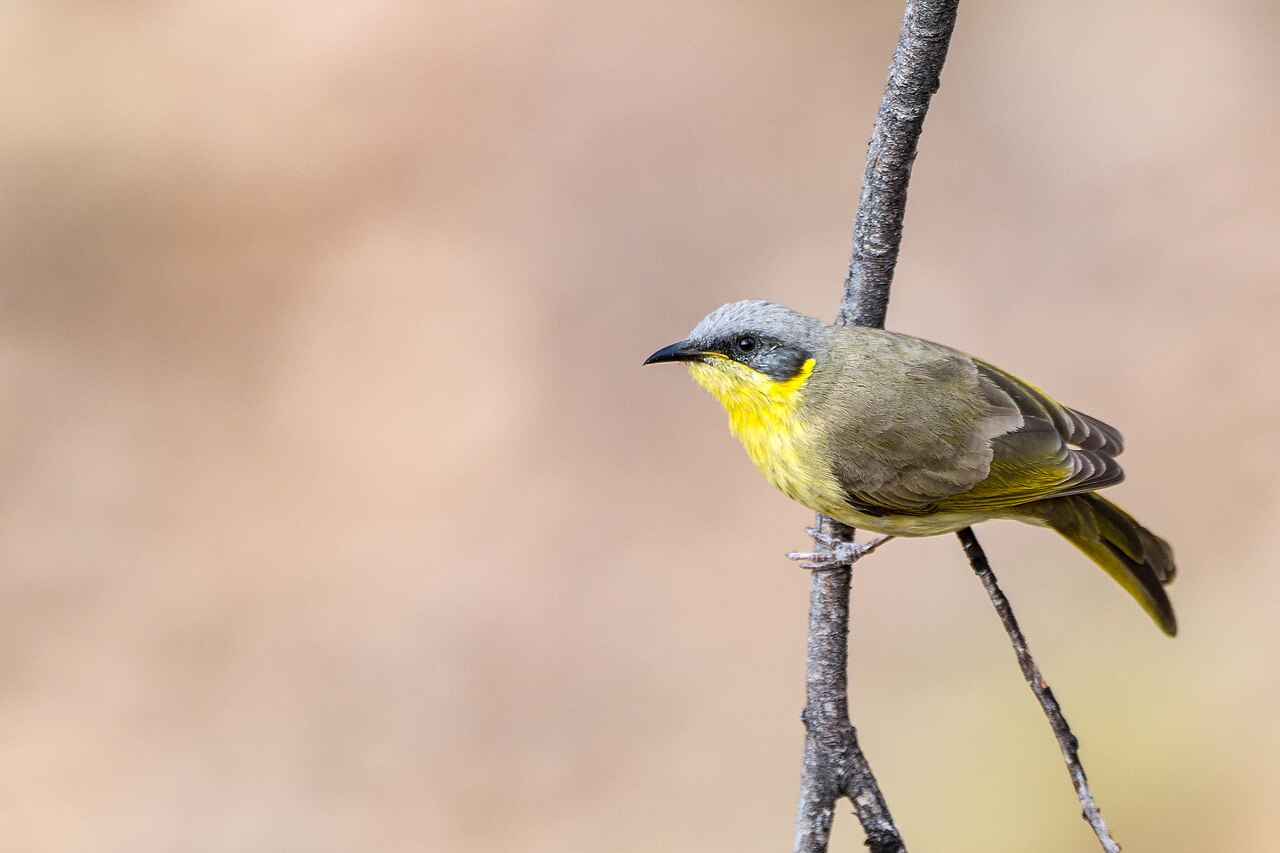
A small honeyeater of thirteen to sixteen and a half centimetres with a short, gently down-curved bill, black with a yellow base to the lower mandible. The head is the mark: a clearly grey crown and, below it, a dark grey to black mask enclosing the eye, sharply bounded by a bright yellow plume pointing down and back from behind the ear coverts. A pale yellow moustachial stripe runs between lores and throat. The upperparts are olive-brown, the underparts olive-yellow streaked with brown. Young birds are paler, with a lighter grey-brown mask and a lighter crown. The sexes look alike.
Confusion species
Grey-fronted Honeyeater (Ptilotula plumula) is the sister species and the real problem: it overlaps over hundreds of kilometres and is the same size and the same olive-brown. The difference lies in the head — plumula has an olive-yellow crown with only a small grey forehead patch, while Grey-headed has the whole crown grey and wears a much darker, more sharply drawn mask — and in the substrate: Grey-headed sits on rock and in gorges, plumula on sandplains in mulga (acacia scrub of the dry interior, dominated by Acacia aneura) and mallee (low, multi-stemmed eucalypt scrub of dry southern Australia). White-plumed Honeyeater (Ptilotula penicillata) shares the inland creeks but has a white rather than a yellow plume and a yellow face with no dark mask. Yellow-tinted Honeyeater (Ptilotula flavescens) sits further north, is yellower and lacks the grey crown. Fuscous Honeyeater (Ptilotula fusca), finally, is plain brown without plume or mask, and does not occur in this part of Australia.
Habitat
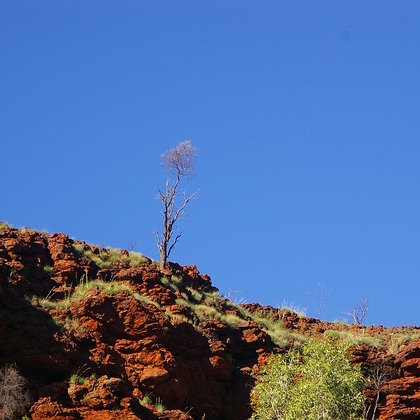
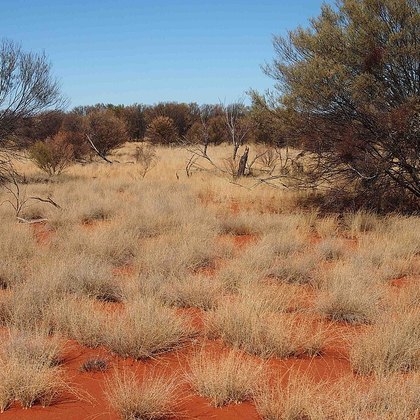
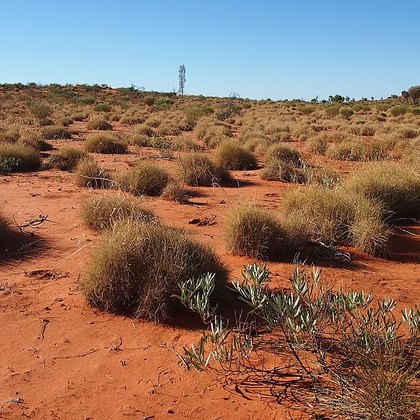
Rugged gullies, gorges and rocky country of the dry interior, with eucalypt scrub and woodland on the slopes, mulga and mallee on the flats between, and creek woodland along the watercourses on the gorge floors — often with spinifex as the ground layer. It takes nectar from flowering hakeas, grevilleas, eucalypts and mallee, supplemented with insects gleaned from foliage and branches and sometimes caught in the air, and with small fruits. The nest sits low in a tree or shrub, the clutch is usually two eggs, and breeding follows rain: after a good fall a whole gorge may fill with nests within weeks, while in dry years there is barely any breeding at all.
Where the bird is most often found, arranged by main group and formation.
Range and movements
The arid and semi-arid interior of northern and central Australia, with the emphasis on the ranges. The range covers some four and a third million square kilometres and runs from the Pilbara in Western Australia through the western interior and Central Australia — the MacDonnell Ranges around Alice Springs are the classic ground — into north-western Queensland. It does not reach the south coast, nor the wet tropical coastal strip in the north. The species does not occur in the east of the continent, in Tasmania or in New Zealand.
- Resident
- dark = core range, pale = thinly spread
Where and when to look
Let the landscape do the work. If you are standing in a rocky gorge or on a stony ridge — the MacDonnell Ranges, the Pilbara, the Hamersley gorges — a small honeyeater with a grey crown and a yellow ear plume is almost certainly this species; if you are on a sandplain in mulga, Grey-fronted Honeyeater is likelier. Confirm it with the crown: entirely grey is keartlandi, olive-yellow with only a grey forehead is plumula. Waterholes on the gorge floor are the best place, because the species must drink daily and turns up there reliably in early morning and late afternoon.
Conservation
Least Concern (LC), with a very large range in a part of Australia where human pressure is low; the rocky gorges it lives in cannot be cleared and are largely free of agriculture. The literature does point to sensitivity to climate change: the species depends on flowering and on daily available drinking water, and in the interior both hang directly on rainfall. Longer droughts and hotter spinifex fires can remove the flowering shrubs of the gorge floors for years. In the short term the species absorbs this by wandering; what sustained shifts would mean is not known.
Scientific name
Ptilotula keartlandi | (North, 1895)
Alfred John North described the species in 1895 as Ptilotis keartlandi; author and year stand in parentheses, because it subsequently moved through Meliphaga and Lichenostomus to Ptilotula, after molecular work in 2011 exposed Lichenostomus as polyphyletic. The generic name Ptilotula, coined by Gregory Mathews in 1912, comes from Greek ptilon, 'feather', and ous, 'ear' — the ear plume, with a diminutive ending. The epithet honours George Arthur Keartland, the Australian collector who secured the type specimen during the inland expeditions of the 1890s. The English name Grey-headed Honeyeater, the Dutch grijskophoningeter and the Spanish mielero cabecigrís all three choose the grey crown and thus depart from the dedication in the scientific epithet.