All species › Tubenoses › Albatrosses › Grey-headed Albatross
Grey-headed Albatross | Thalassarche chrysostoma
Grijskopalbatros | Albatros cabecigrís
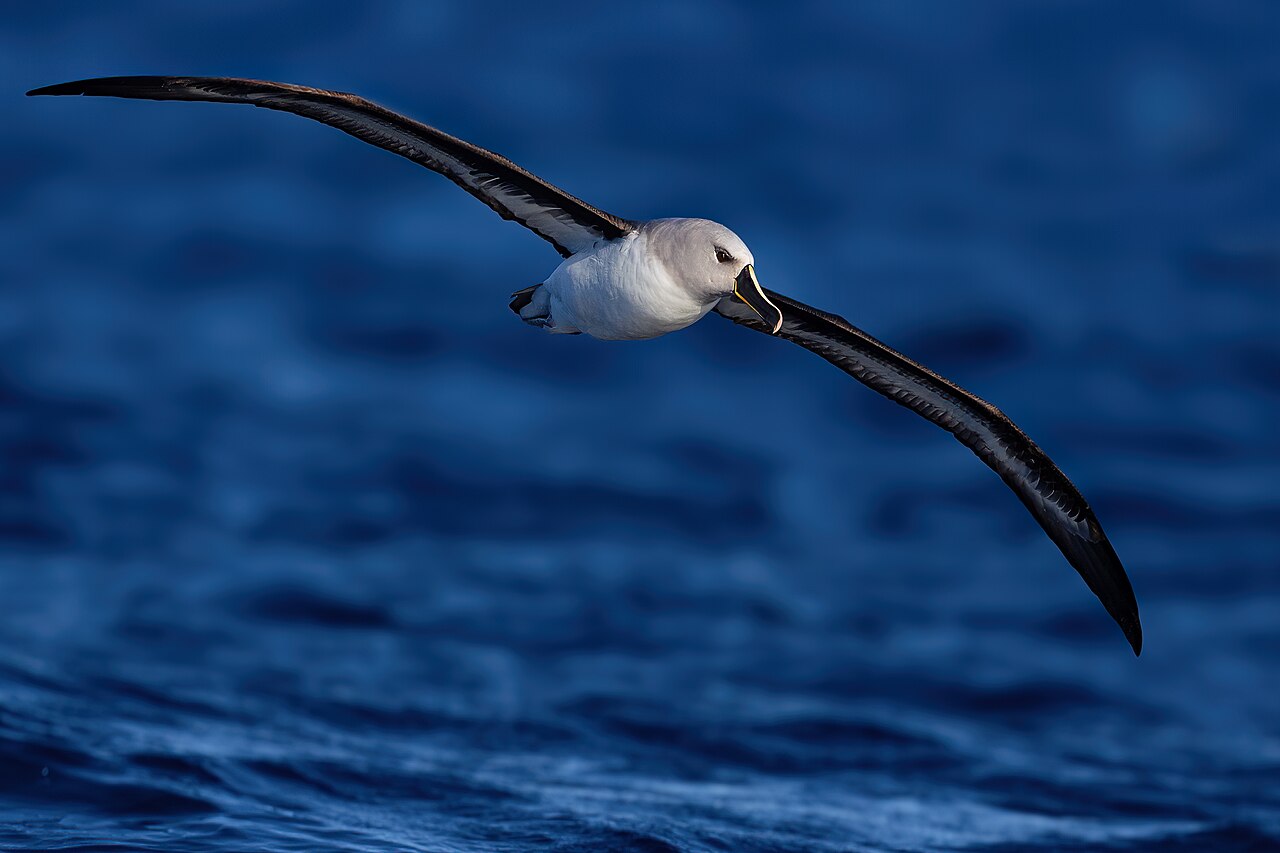
The Grey-headed Albatross is a mollymawk (an albatross of the genus Thalassarche) with an evenly ash-grey head and a black bill carrying a bright yellow ridge above and below that shades to pink-orange at the tip. It is the albatross of the coldest water: while breeding it takes its squid at and south of the Antarctic Polar Front, and within this guide's window it breeds only on Campbell and on Macquarie.
Voice
At sea it is rarely heard, at most a growling rasp around floating food. At the colony it gives a braying call with repeated nap-nap-nap notes, and with it a grating sound that has been likened to a chainsaw starting. Pairs clatter their bills and moan softly during mutual preening; chicks beg with a sustained piping.
Recording: Santiago Imberti — CC BY-NC-SA 4.0 · Bartolome Island, Diego Ramirez Archipelago, Chile · xeno-canto
Identification
About eighty-one centimetres and three kilos, with a wingspan of some two metres twenty. Head, throat and upper neck are an even dark ash-grey, with a narrow white crescent just behind the eye; the rest of the underparts are white, the mantle, upperwing and tail blackish brown. The bill is black with a bright yellow ridge along the top and along the lower edge, turning pink-orange at the tip — that yellow above and below is the best mark. The underwing is white with a broad dark leading edge, widest at the 'elbow'. Young birds have a wholly dark bill and a darker, brownish grey head sometimes showing a paler cheek, and are then hard to separate from young Black-browed Albatrosses.
Confusion species
Buller's Albatross (Thalassarche bulleri) likewise has yellow above and below on a black bill, but wears a silvery-white cap on the forehead that cuts sharply against the dark grey face, and its dark underwing margin is clearly narrower. Both yellow-nosed albatrosses (T. carteri, T. chlororhynchos) are smaller and slimmer, with a longer bill that is yellow only along the top and black along the lower edge. Young Black-browed Albatross (T. melanophris) is the closest match: it has a paler, dingy grey collar rather than an evenly dark grey head, and more contrast between bill base and tip. Salvin's Albatross (T. salvini) and Chatham Albatross (T. eremita) are larger, with a paler grey hood and a grey-green or yellow bill bearing a black tip to the lower mandible. The great albatrosses (Diomedea exulans, D. epomophora) are far larger and whiter; the sooty albatrosses (Phoebetria palpebrata, P. fusca) are wholly dark with a wedge-shaped tail.
Habitat
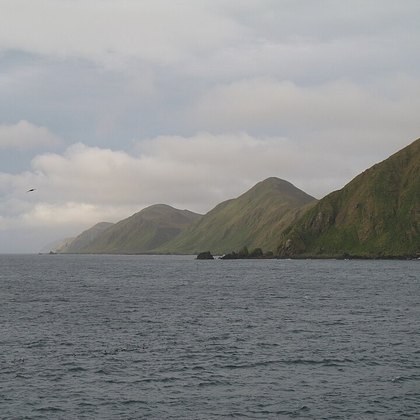
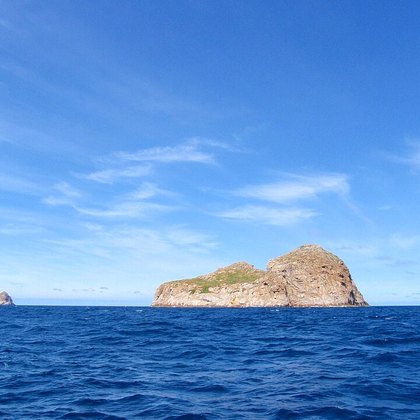
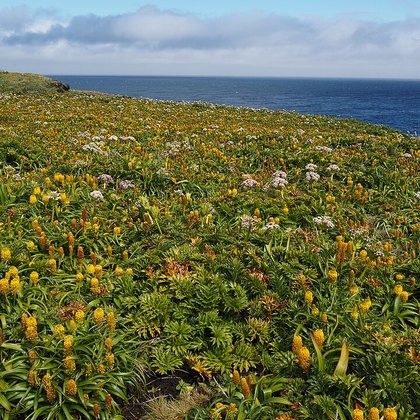
Cold subantarctic and Antarctic water, above all around the Polar Front and over seamounts and fronts where squid gather; of all mollymawks (albatrosses of the genus Thalassarche) it keeps furthest from temperate inshore water. It follows ships less faithfully than the Black-browed. Breeding is in colonies on steep, wet cliff slopes with tussock (grassland of loose, tall clump-forming grasses, especially in New Zealand) and ferns on subantarctic islands, often on all but unreachable terraces above the sea.
Where the bird is most often found, arranged by main group and formation.
Range and movements
Within this guide's window it breeds on Campbell Island, where some six thousand six hundred pairs sit on the coastal cliffs, and in a small colony of around eighty-five pairs on Macquarie; the world's largest numbers lie outside this window on South Georgia and the Diego Ramirez Islands. At sea it is mainly a bird of the subantarctic part of the window: regular on voyages to the New Zealand subantarctic islands and in the Southern Ocean, but far scarcer over the mainland shelf. Off Australia and the New Zealand main islands it is an irregular visitor, most often reported in winter on pelagic trips.
- Breeding (summer)
- dark = core range, pale = thinly spread
Where and when to look
To be sure of it, book a ship to the New Zealand subantarctic islands or run well south of the South Island; on ordinary inshore pelagics it is the exception rather than the rule. On every grey-headed mollymawk (an albatross of the genus Thalassarche) look for yellow along the lower edge of the bill, which separates it at once from the yellow-nosed albatrosses, and note the broad dark leading edge of the underwing. Because it breeds every second year, adults are at sea even during the breeding season.
Conservation
Endangered (EN): the world population is put at roughly a quarter of a million mature birds but has been falling for decades, with a calculated decline of thirty to forty per cent over ninety years. Longline bycatch weighs heaviest, particularly in fleets targeting toothfish and tuna. On Campbell, the only New Zealand colony, food supply matters too: shifts in the Polar Front change where the squid are. New Zealand moved the species back from Nationally Critical to Nationally Vulnerable in 2013, which points to a cautious recovery.
Scientific name
Thalassarche chrysostoma | (Forster, 1785)
Johann Reinhold Forster described the species in 1785 as Diomedea chrysostoma, from material he collected as naturalist on Cook's second voyage through the southern ocean; author and year stand in parentheses because the species now sits in Thalassarche. The epithet is from Greek khrusos ('gold') and stoma ('mouth'), for the golden ridges on the bill — exactly the feature the identification turns on. The Maori name toroa covers albatrosses in general.