All species › Passerines › Woodswallows, bellmagpies and allies › Grey Butcherbird
Grey Butcherbird | Cracticus torquatus
Grijsrugorgelvogel | Verdugo acollarado
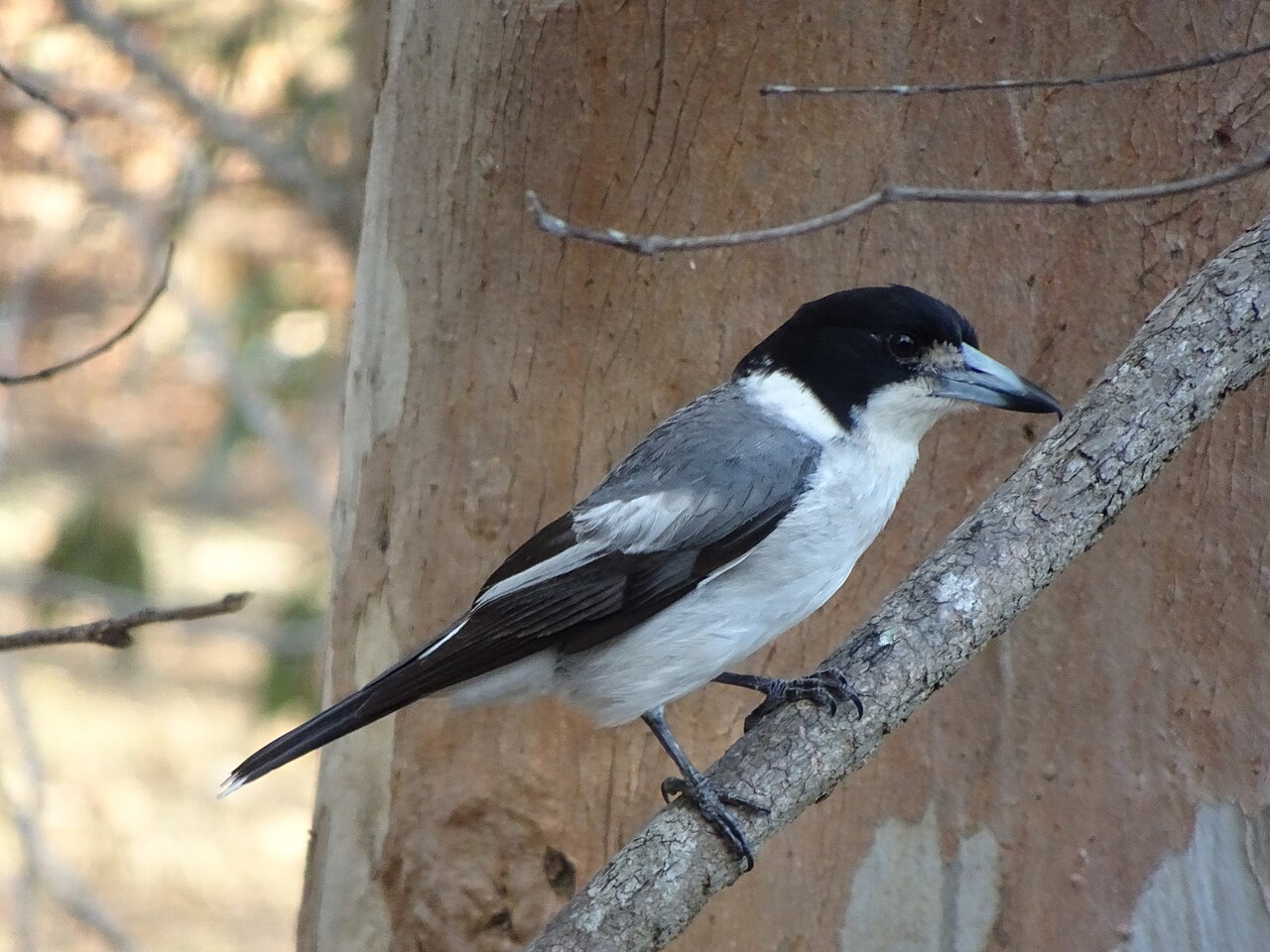
The Grey Butcherbird is a songbird with the bill of a raptor: hardly bigger than a blackbird, but carrying a heavy blue-grey hook with which it takes lizards, insects and nestlings. What it does not eat at once it wedges in a fork or impales on a thorn — the habit that gave the whole family its name. And it sings superbly.
Voice
The song is a rich rolling pipe of clear, organ-like notes, often in duet: the pair sings in turn and so tightly interlocked that it sounds like one bird. Such bouts can run for a quarter of an hour or more, strongest at first light in late winter and spring. There is also a harsh rattling scold, and the song carries occasional imitations of neighbours.
Recording: James Ray — CC BY-SA 4.0 · Faulconbridge, Blue Mountains City Council, New South Wales, Australia · xeno-canto
Identification
A compact bird of 24 to 30 centimetres with a large head and a heavy blue-grey bill hooked and black at the tip. Head and face are black, the throat white, and a thin white collar runs between them; the back is grey, the underparts white, and a long white stripe runs along the wing. The eye is dark brown, the legs grey. Females are slightly smaller; young birds are olive-brown where the adult is black.
Confusion species
Pied Butcherbird (Cracticus nigrogularis) is larger and more sharply black and white, with a black hood covering the throat as well. Black Butcherbird (Melloria quoyi) is all black with a blue-grey bill and keeps to northern rainforest and mangrove. Black-backed Butcherbird (C. mentalis) is confined to Cape York. Silver-backed Butcherbird (C. argenteus) of the Kimberley and the Top End has a paler, silvery-grey back; where the two meet, range is the best guide. Australian Magpie and the currawongs are far larger, with a yellow eye or a white back.
Habitat
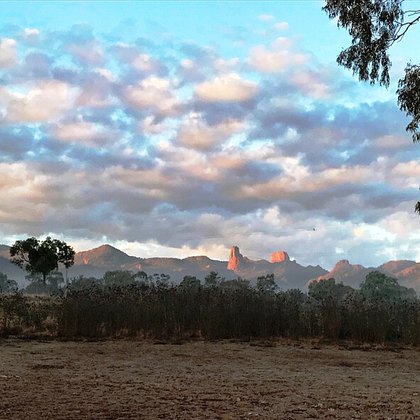
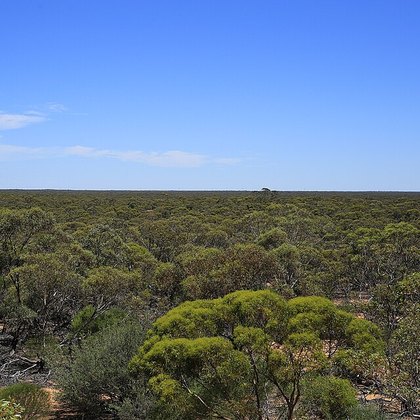
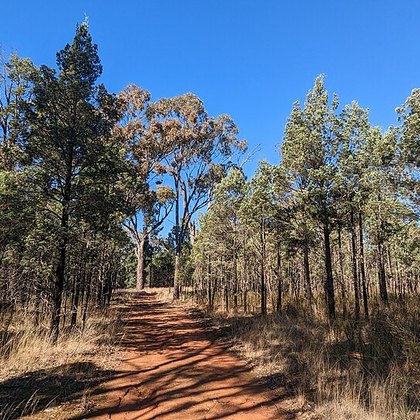
Dry eucalypt woodland and open forest are the core, with mallee (low, multi-stemmed eucalypt scrub of dry southern Australia), casuarina and callitris woodland and acacia scrub alongside. It needs a lookout — a dead branch, a post, a wire — with open ground or low cover beneath it to drop onto. Gardens, parks and town edges with large trees it takes up without hesitation, and there it becomes tame.
Where the bird is most often found, arranged by main group and formation.
Range and movements
Most of Australia except the far north and the bare deserts: from mid-eastern Queensland through New South Wales, Victoria, Tasmania and South Australia into the south-west. In the tropical north, from the Kimberley to Arnhem Land, it is replaced by Silver-backed Butcherbird (Cracticus argenteus), which is treated as a separate species. It does not migrate; a pair holds the same territory for years.
- Resident
- dark = core range, pale = thinly spread
Where and when to look
From August, stand in a garden or along a woodland edge at first light and wait for the duet; the song is the quickest and surest mark. Then find the bird on a projecting dead branch with a clear view. Check barbed wire, thorny shrubs and tree forks for a larder: a gecko, a grasshopper or a nestling wedged in for later.
Conservation
Least Concern (LC). The species is widespread and numerous and has adapted well to gardens and town edges, where it profits from supplementary food and from the cover of ornamental shrubs. Where dry woodland has been cleared wholesale, or too many trees with dead branches removed, the lookouts go and the bird with them; cats cost fledglings locally.
Scientific name
Cracticus torquatus | (Latham, 1801)
Latham described the species in 1801 as Lanius torquatus, among the shrikes — some lists date the work to 1802 — and the later move puts author and year in parentheses. The genus Cracticus was introduced by Vieillot in 1816, from Greek kraktikos, 'noisy, clamorous'. torquatus is Latin for 'collared', after the white band on the neck.