All species › Passerines › Honeyeaters › Graceful Honeyeater
Graceful Honeyeater | Meliphaga gracilis
Priemsnavelhoningeter | Mielero grácil
The Graceful Honeyeater is the smallest and the finest-billed of the brown Meliphaga honeyeaters and the only one that also occurs outside Australia: its range runs from southern New Guinea and the Aru Islands across the Torres Strait to the north of Cape York. Until 2021 it and the Cryptic Honeyeater counted as one species; since the two were separated it has become, on Australian ground, a northern Cape York bird. Unlike its silent counterpart it is moreover a strikingly talkative species.
Voice
A rich repertoire: as many as twelve different vocalisations have been distinguished, among them a true song — an exception, because the Cryptic Honeyeater to the south has only two simple calls and does not sing. The difference is so great that it formed the main ground for the split: in trials the two forms do not respond to one another's calls. Beside these comes a sharp, high contact note that betrays its presence in the foliage.
No recording with a suitable Creative Commons licence has been found for this species yet; what to listen for is described below.
Identification
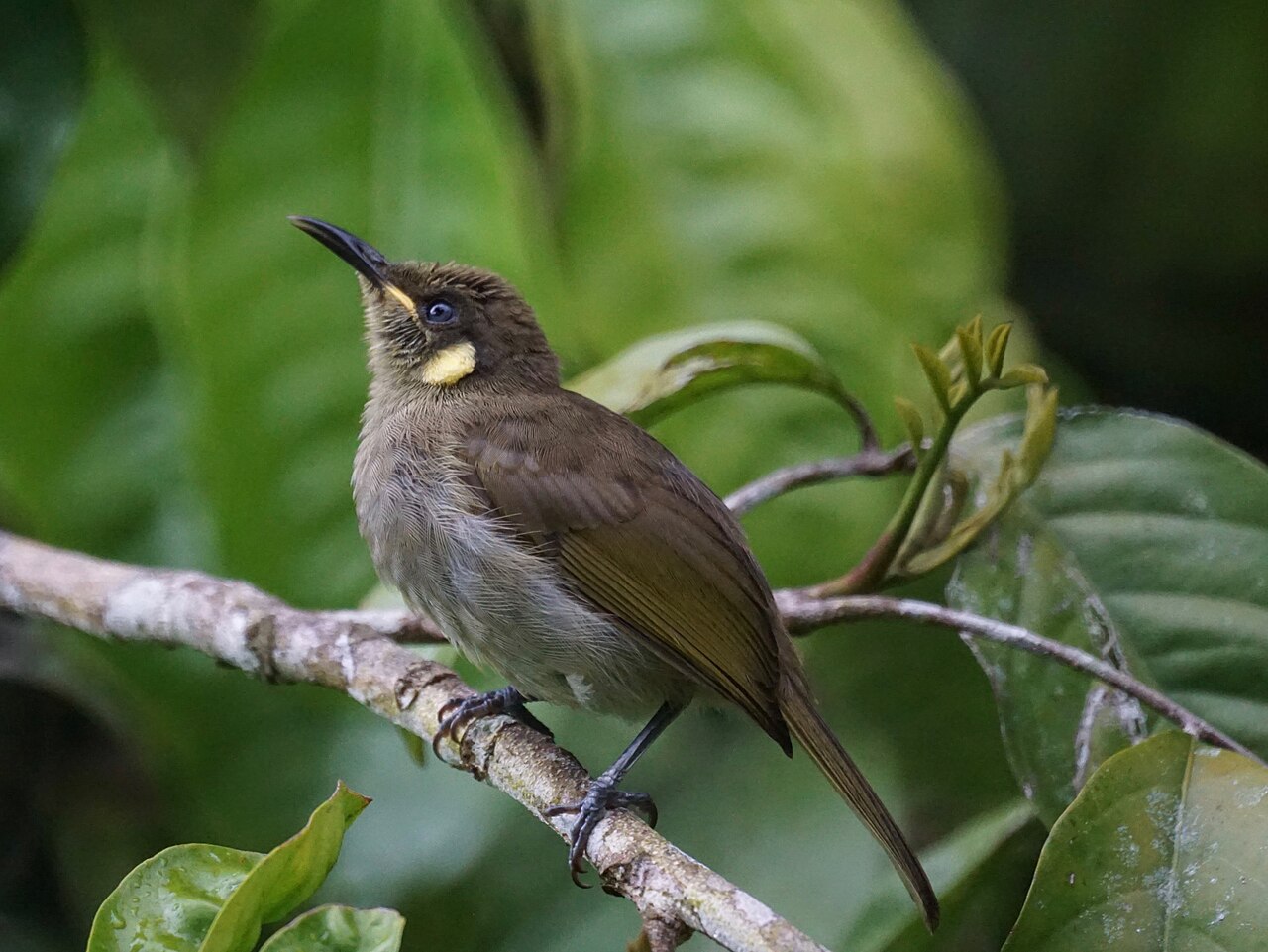
Fourteen to seventeen centimetres: a small, slender honeyeater with a grey-brown head and a strikingly thin, slightly decurved dark grey bill — the character its Dutch name takes hold of. The ear patch is pale yellow and round, without an extension. It is pale greyish brown below and darker greyish brown above, with an off-white belly and undertail-coverts. The gape is orange-yellow and the iris dark brown. Male and female are alike.
Confusion species
The Cryptic Honeyeater (Meliphaga imitatrix) is the great problem, since until 2021 the two were one species and the difference is extremely subtle: that bird is darker and more olive-green with more uniform underparts, has an ear patch running out behind into a diffuse yellow extension, a dull yellow gape and a navy-blue iris, where this species looks more yellowish with a paler belly, a purely round ear patch, an orange-yellow gape and a dark brown iris. At distance and against the light none of this can be read. What does work is the map: between the two range edges on Cape York lies a gap of about a hundred and forty kilometres with no intermediate birds. The Yellow-spotted Honeyeater (Meliphaga notata), with which it does occur together on Cape York, is larger and darker with an oval ear patch, and calls a loud repeated whistle; Lewin's Honeyeater (Meliphaga lewinii) is bulky, has a crescent-shaped ear patch and rattles like a machine gun.
Habitat
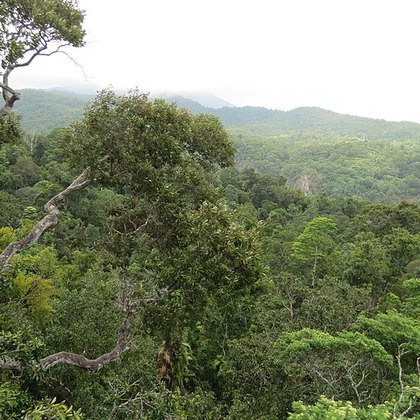
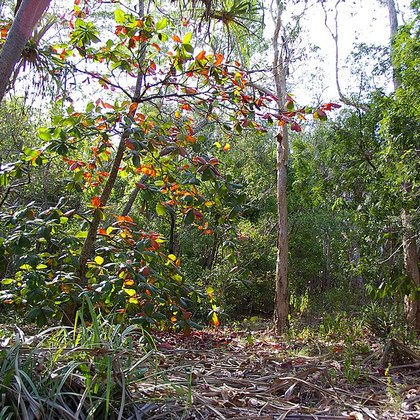
Moist tropical lowland forest: rainforest and its edges, monsoon forest and vine thicket, mangrove forest and melaleuca swamp forest along the coast and the floodplains. It keeps to the middle and lower storeys, where it drinks nectar from flowering Grevillea among others and takes fruit and insects. It is territorial and is usually seen alone or in pairs.
Where the bird is most often found, arranged by main group and formation.


Range and movements
Southern New Guinea including the Aru Islands, the western islands of the Torres Strait, and in Australia the eastern and northern part of Cape York Peninsula in north Queensland. The type locality is Cape York. Resident, with small movements following the flowering. Within this guide it is therefore a bird of the extreme northern tip of the continent only.
- Resident
- dark = core range, pale = thinly spread
Where and when to look
Use the map as the first filter and the voice as the second. On northern Cape York a small, thin-billed Meliphaga is this species; south of the gap it is the Cryptic Honeyeater. A small Meliphaga that sings or produces a varied repertoire is almost certainly this bird. Finally, watch the bill: of all six it is the thinnest and most strongly curved here, though that does call for a bird in the binoculars at short range.
Conservation
Least Concern (LC); the range is large, lies for an important part in thinly settled country on Cape York and New Guinea, and the species is common within it. It should be said, though, that since the split of the Cryptic Honeyeater the Australian population is smaller than the old figures suggest, and that all counts from before 2021 combine the two species; an independent trend for this species therefore cannot yet be established.
Scientific name
Meliphaga gracilis | (Gould, 1866)
John Gould described the bird in 1866 as Ptilotis gracilis, from material from Cape York; because the species was later placed in Meliphaga, author and year stand in parentheses. gracilis is Latin for 'slender, graceful', after the fine build and the thin bill, and the English name follows that word directly, while the Dutch name names the character itself — the awl-shaped bill. For the genus Meliphaga, from Greek meli (honey) and phagos (eating), see Lewin's Honeyeater; between 2019 and 2025 the species was also carried in the genus Microptilotis.