All species › Pigeons and doves › Doves and pigeons › Flock Bronzewing
Flock Bronzewing | Phaps histrionica
Harlekijnduif | Paloma bronce arlequín
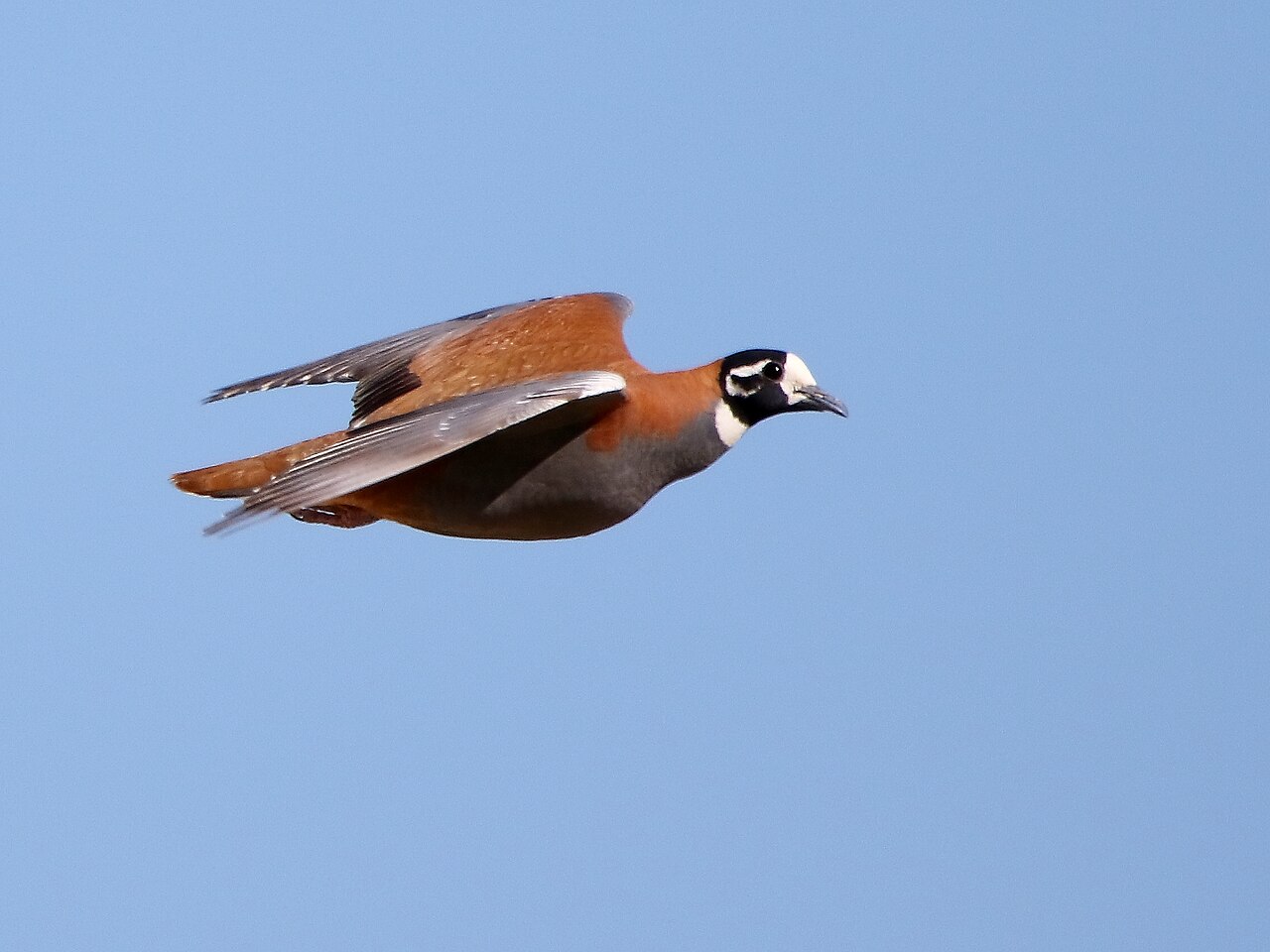
The Flock Bronzewing is the pigeon of the inland plains and of sheer numbers: a sandy, slender bronzewing with a sharply painted black-and-white head, roaming in flocks and turning up wherever rain has happened to fall. Of all Australian pigeons it is the most nomadic; a district can stand empty for years and then suddenly be full of them.
Voice
A markedly silent pigeon. What there is is a soft, low, short coo, little more than a muffled oom, which barely carries across open plain and which in practice you seldom hear. The sound that really names the species is mechanical: the heavy, rushing noise of tens to hundreds of pairs of wings as a flock drops low and fast across the grassland towards water at sunset.
No recording with a suitable Creative Commons licence has been found for this species yet; what to listen for is described below.
Identification
A medium-sized, slender pigeon of around thirty centimetres, reddish sandy-brown above — exactly the colour of dry Mitchell grass — with grey lesser wing coverts. The head makes the species: in the male it is largely black with a white forehead, a white throat patch and a white line that curves forward from behind the eye and all but encloses the ear coverts, so that the face looks painted. The bill is black, the eye dark brown. The female has a sandy-brown forehead and crown and a far duller black-and-white face pattern, and lacks the white tips to the primaries the male shows in flight. Young birds are paler still and almost unmarked.
Confusion species
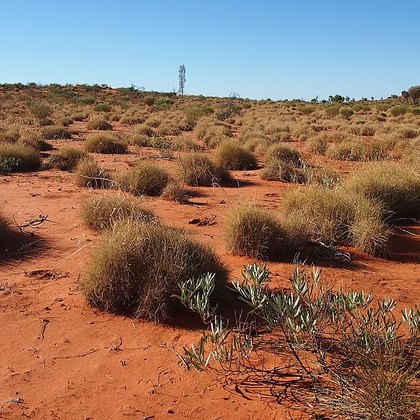
Common Bronzewing (Phaps chalcoptera) is larger and heavier, olive to earth brown rather than sandy, with a white line below the eye but no black-and-white mask, and with glossy wing panels the Flock Bronzewing all but lacks; it is also found almost everywhere, while the Flock Bronzewing is tied to open plain. Brush Bronzewing (Phaps elegans) is dark olive-brown with a chestnut nape and throat patch and lives in dense coastal heath in the south — range and habitat rule out any mix-up. Inland it does share country with Spinifex Pigeon (Geophaps plumifera), but that bird is barred rufous, carries a long upright crest and bare red facial skin, and keeps to rocky spinifex (spiny, hummock-forming desert grass of the interior) ground.
Habitat
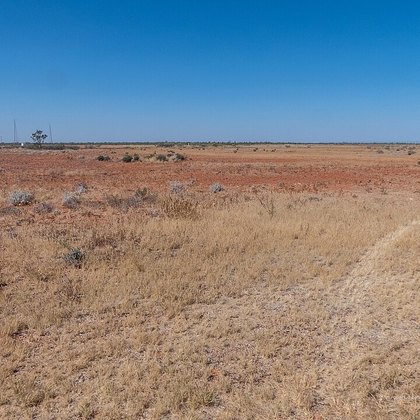
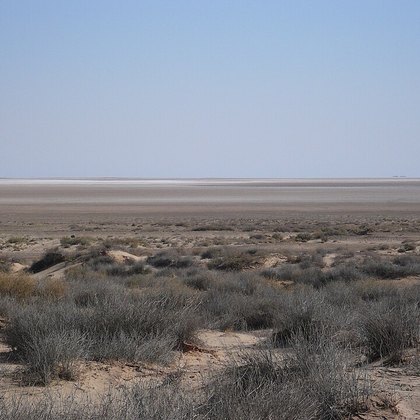
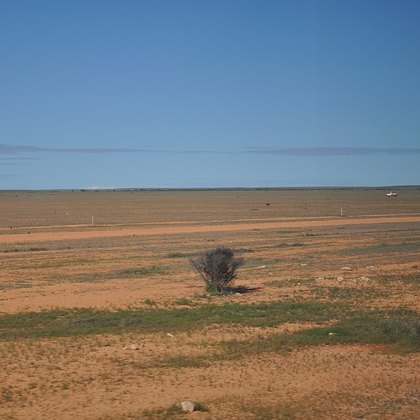
Open, treeless to sparsely vegetated plains of the dry interior: Mitchell grassland on black clay plains, tussock grassland with low shrubs, and the margins of claypans (shallow clay basin that holds water for a time after rain) and ephemeral lakes. It feeds on foot on the ground on grass seed and nests in a scrape on the ground lined with a little grass and twigs, usually in the lee of a tussock. Water is the only place it concentrates.
Where the bird is most often found, arranged by main group and formation.
Range and movements
The arid interior of Australia, with the Barkly Tablelands of the eastern Northern Territory and western Queensland its core area and stronghold. Beyond that it appears irregularly in the Kimberley of Western Australia, in northern South Australia and in north-western New South Wales — where it is depends on where the rain last fell. On the Liverpool Plains of New South Wales, where the species was discovered in 1839, it no longer occurs. It is absent outside Australia, New Zealand included.
- Resident
- Winter
- dark = core range, pale = thinly spread
Where and when to look
Do not look for the bird, look for its water: stand in the late afternoon at a dam, a bore or a remaining pool on a Mitchell grass plain and wait for the last hour before sunset, when the flocks come in low in waves, drink briefly and are gone. Travel there after a good wet season — in dry years the same district can stay utterly empty for months.
Conservation
Least Concern (LC), but with a distinctly smaller story than it once had. From the nineteenth century and the early twentieth come accounts of very large flocks — a hundred thousand birds at one waterhole in 1931, fifty thousand in a single flock in 1972 — and such numbers are no longer reported. Grazing stock removed the grass seed and the cover the species depends on for food and nests, and that cost it the south-eastern part of its range. Against that pressure stands the fact that artificial water on pastoral properties has widened its room to move inland, so that in its core area the species is still numerous.
Scientific name
Phaps histrionica | (Gould, 1841)
John Gould described the species in 1841 in The Birds of Australia and first placed it in the genus Peristera; author and year therefore stand in parentheses now the bird sits in Phaps, the genus Selby introduced in 1835 and whose name is the Ancient Greek word for a wild pigeon. The epithet histrionica means 'of the actor' and refers to the theatrical black-and-white face paint — the same figure of speech that produced 'harlequin' in the Dutch and Spanish names. The type locality is the Mooki River on the Liverpool Plains, New South Wales, where Gould met with the bird in 1839.