All species › Parrots › Old World parrots › Eastern Rosella
Eastern Rosella | Platycercus eximius
Prachtrosella | Perico multicolor
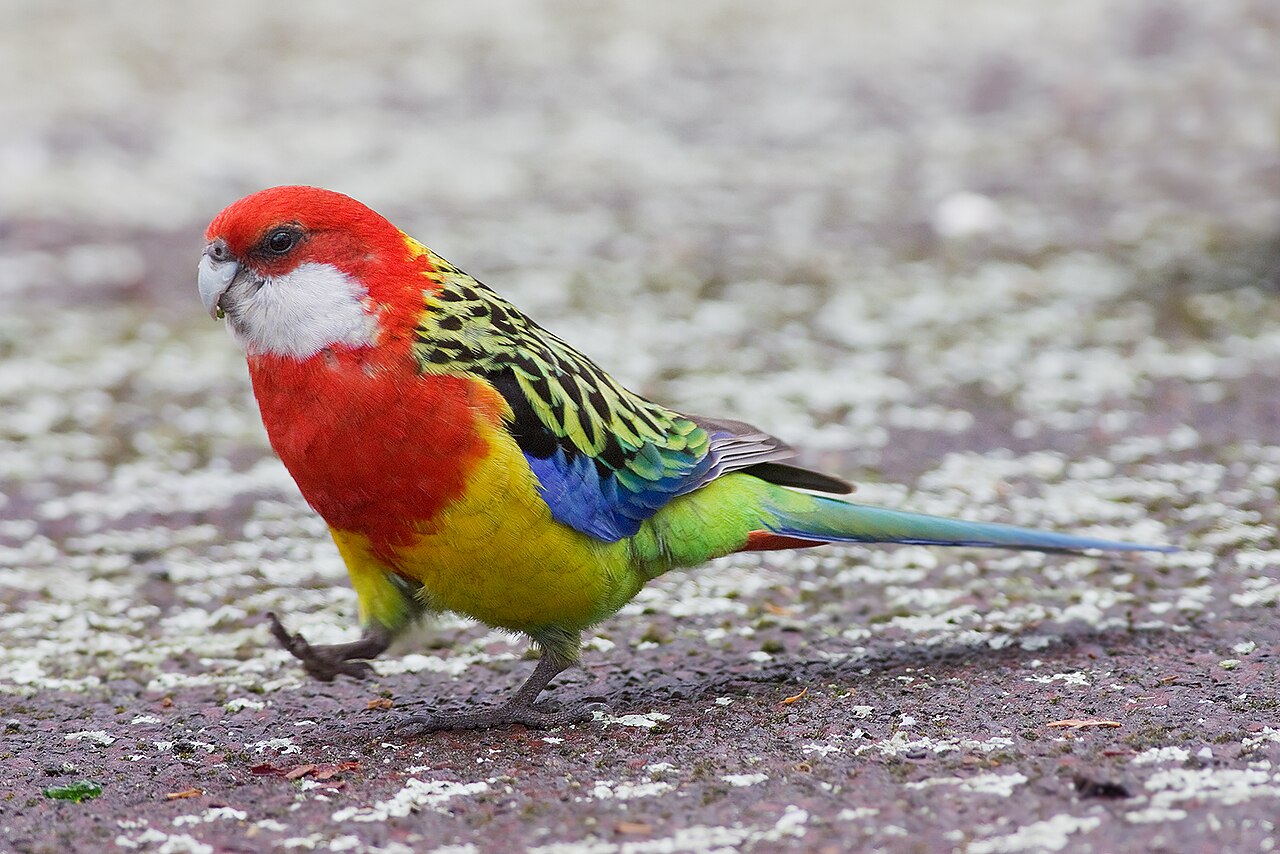
The Eastern Rosella is the most gaudily patterned parrot of the open eastern country: red head and breast, white cheek patches, yellow belly, yellow-green rump and a mantle scalloped black on yellow. It belongs to thinned woodland, to horse paddocks and golf courses, and it is the rosella most people first see close to. In New Zealand it has lived as an introduced bird for over a century.
Voice
In flight a sharp repeated chut-chit-chut, three or four short ticks in a row, by which parties keep contact. Perched, a high thin pee-pt-eee or a two-syllable kwink kwink that carries the width of a paddock. Alarm brings a hard rattling screech. A flock feeding on the ground talks softly and continuously through it all, and that murmur is often the first sign.
Recording: David Darrell-Lambert — CC BY-NC-SA 4.0 · Queen's Wood, Greater London, England, United Kingdom · xeno-canto
Identification
A slim parrot of around thirty centimetres with a long broad tail. Head, neck and breast are bright red, with sharply bounded white cheek patches that fix the species at a glance. The belly is yellow, running to yellow-green on the rump, with a red patch under the tail. The mantle is black with broad yellow or green-yellow feather edges, giving a finely scaled back; the shoulder is bright blue and the tail blue-green. The female resembles the male but is usually duller, with a less red face and a pale stripe across the underwing; juveniles are duller still and show the same stripe. Bill colour runs from yellow or orange in young birds to off-white in adults.
Confusion species
Crimson Rosella (Platycercus elegans) is larger and wholly red with cobalt cheeks instead of white, and prefers wetter, taller forest. Pale-headed Rosella (Platycercus adscitus) of Queensland is the nearest relative and has a pale yellow head with blue cheeks and no red, and the two interbreed where their limits meet. Green Rosella (Platycercus caledonicus) of Tasmania is larger, yellow with a red band above the bill. At long range an Eastern Rosella can suggest a party of Rainbow Lorikeets, but those fly faster, straighter and far more noisily.
Habitat
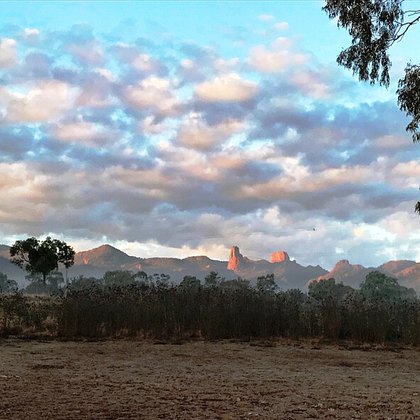
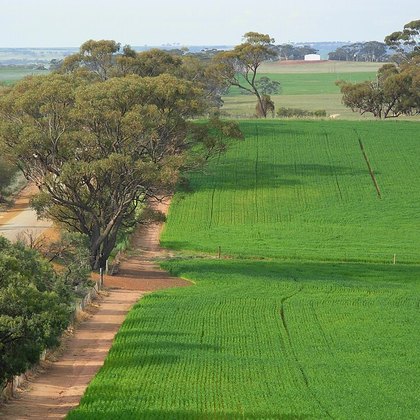
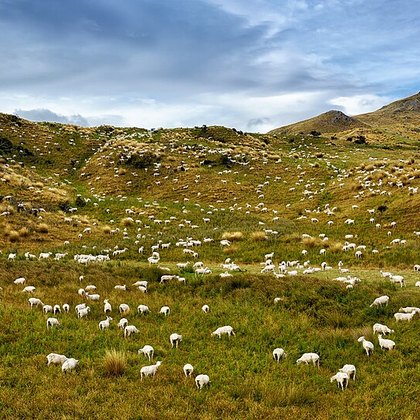
Open eucalypt forest and thinned woodland with grass beneath, forest edge, shelterbelts and bush remnants in farmland; it avoids closed tall forest. Beyond that grain paddocks, grazing land with scattered trees, orchards, road verges, parks, gardens and golf courses. It takes nearly all its food on the ground: grass seed, weed seed, spilt grain, buds and insects. It nests in a hollow in an old eucalypt, often low, and sometimes in a post, a fence or a nest box.
Where the bird is most often found, arranged by main group and formation.

Range and movements
South-eastern Australia, from south-eastern Queensland through New South Wales and Victoria to south-eastern South Australia, and in eastern Tasmania. Inland it stops where woodland gives way to mulga (acacia scrub of the dry interior, dominated by Acacia aneura) and saltbush (salt-tolerant dwarf shrubland of saline plains). In New Zealand it has been established since about 1910, when a shipment of birds was put over the side off Otago Heads and others escaped at Dunedin in a gale; it now holds Northland, the Waikato, Taranaki and the Hutt Valley, and the country around Dunedin. It neither migrates nor wanders much.
- Resident
- dark = core range, pale = thinly spread
Where and when to look
Drive a country road early where woodland meets pasture and watch the verges: Eastern Rosellas take seed on the ground there and flush only at close range, with that sharp chut-chit-chut. The white cheek patch is the most reliable mark in any light, even on a dull bird. In New Zealand an orchard or a park near Dunedin repays a visit; the birds sit lower and quieter there than in Australia.
Conservation
Least Concern (LC) and common over most of its range; the thinning of forest for grazing has helped rather than harmed it, since the half-open structure is exactly what it needs. Where the last old timber goes out of a paddock it goes too: nest hollows occur only in old trees, and posts and fences do not make up the difference. Beyond that it loses nests to starlings and honeybees, and birds die on roads because they cross them low.
Scientific name
Platycercus eximius | (Shaw, 1792)
Shaw described the species in 1792 as Psittacus eximius; because it was later moved to another genus, author and year stand in parentheses. The genus Platycercus was introduced by Vigors in 1825, from Greek platus, 'broad', and kerkos, 'tail'. eximius is Latin for 'choice' or 'out of the ordinary'. Three subspecies are recognised: eximius in Victoria and southern New South Wales, elecica with a golden mantle in the northeast, and diemenensis in eastern Tasmania.