All species › Passerines › Honeyeaters › Dusky Myzomela
Dusky Myzomela | Myzomela obscura
Bruine dwerghoningeter | Mielero sombrío
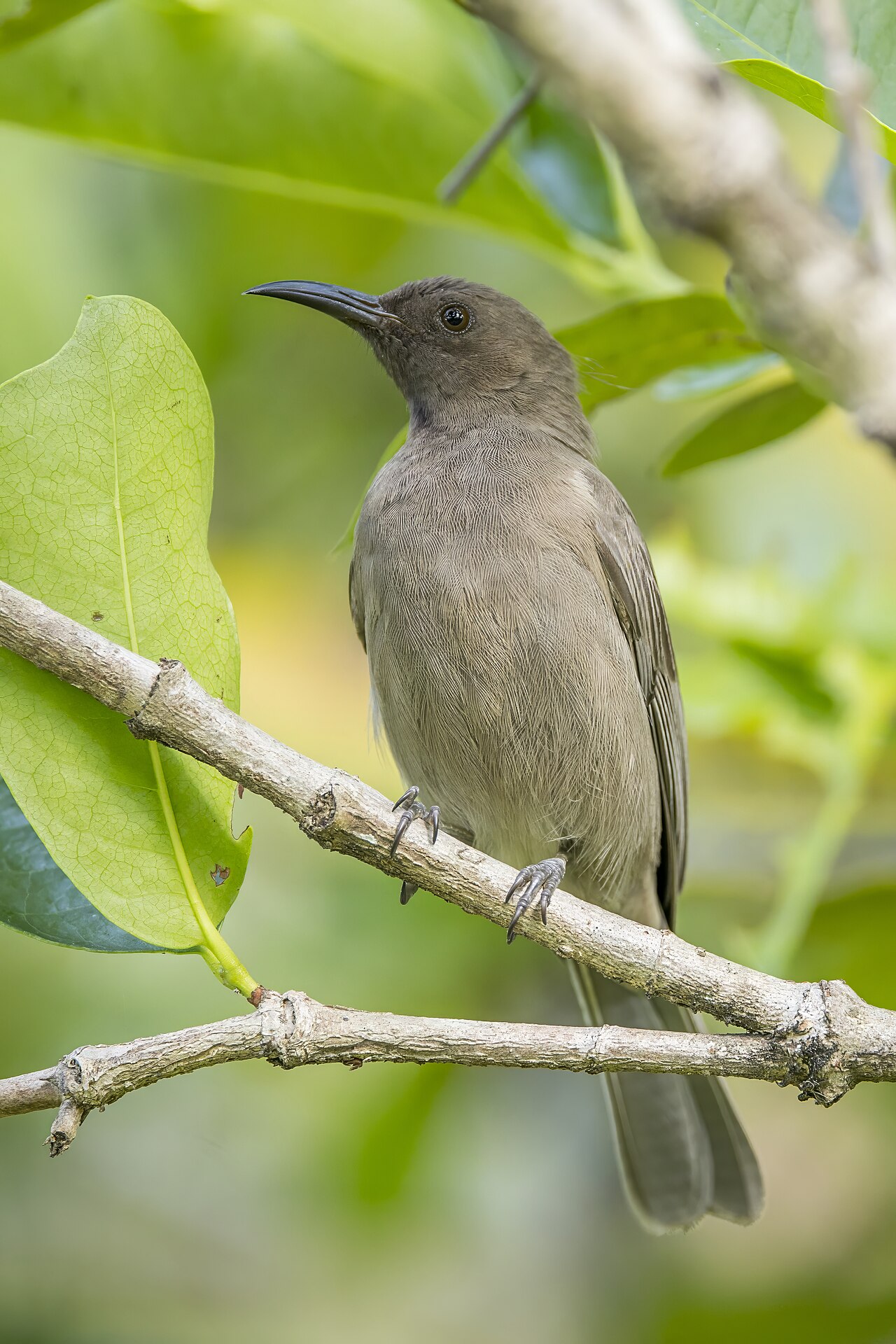
The Dusky Myzomela is the colourless one of the three Australian myzomelas: where its two relatives wear a fiery red or scarlet head, it is plain dull brown from bill to tail. Small, sharp-billed and never still, it feeds high in flowering trees and regularly hovers in front of a blossom. It is a bird of the tropical and subtropical east coast and the Top End, favouring rainforest edges, mangrove and swamp forest — almost always close to water.
Voice
A high, clear and strikingly loud chew-eet or sweet, usually repeated in short series, and a fast, sharp chatter during chases — of which there are many, for the species is fiercely territorial at flowering trees for its size. The song is a quick run of clear high notes. For so small a bird the voice carries far, and in dense canopy it is often the only thing that betrays its presence.
Recording: Étienne Leroy — CC BY-NC-SA 4.0 · Coen, Cook Shire, Queensland, Australia · xeno-canto
Identification
A very small honeyeater of twelve to fifteen centimetres, with a fine, slightly decurved black bill and a short tail. The plumage is monotonous: dull brown to grey-brown all over, a little darker on head and wings and a little paler on the belly, without streaking, spotting or any head pattern. The sexes cannot be told apart by plumage; males are, however, noticeably larger and heavier. Immatures are paler brown with a darker forehead, on which a faint crimson wash sometimes lies, and with a yellow to orange-yellow gape. Behaviour is characteristic: restless, quick from flower to flower, regularly hovering and often high in the crown.
Confusion species
Within the genus the males are easy to separate — Red-headed Myzomela (Myzomela erythrocephala) has a fiery red head and rump, Scarlet Myzomela (Myzomela sanguinolenta) a scarlet head, back and breast, and this species is entirely brown. With females it is far harder: in all three they are largely dull grey-brown and closely resemble Dusky Myzomela. Then watch size and any red tones: females of the two red species usually still show a trace of red on forehead, chin or throat and are smaller and paler, while this species is larger, darker and completely uniform. Immatures of this species may themselves carry a faint red wash on the forehead, which reverses the argument — so be cautious with it. In northern mangroves it overlaps with Red-headed Myzomela, which produces the hardest situation of all; separation there rests mainly on size, on the complete absence of red in adults, and on voice.
Habitat
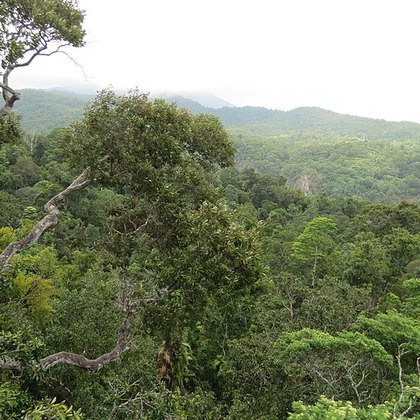
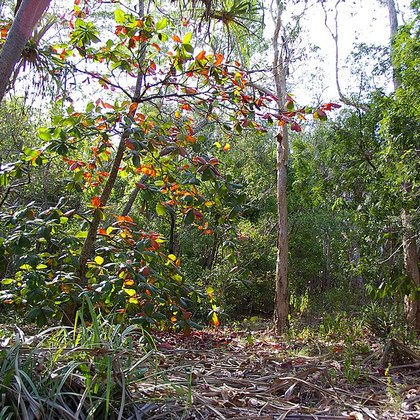
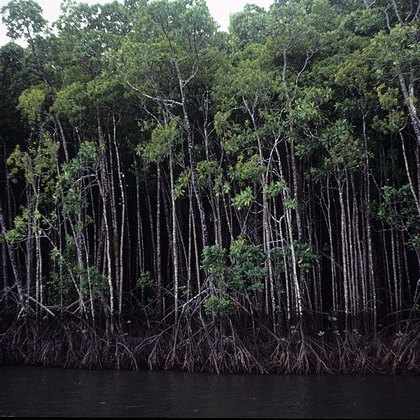
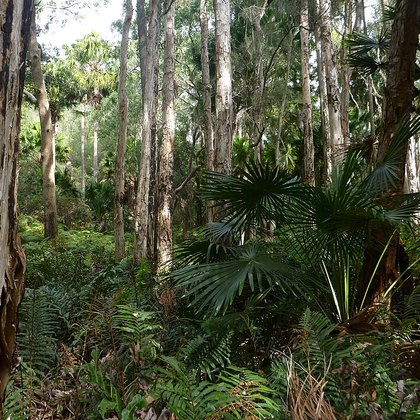
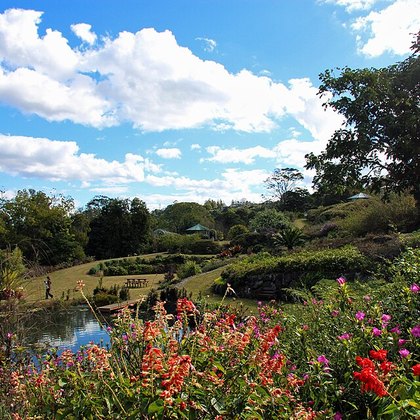
A broad span of moist, wooded habitats, almost always near water: monsoon forest and vine thicket, edges and gaps in tropical rainforest, mangrove, melaleuca swamp forest along floodplains, timbered creeks and open woodland, and beyond that gardens, parks and street plantings in coastal towns. It takes nectar from eucalypt, melaleuca, grevillea and mangrove trees and catches insects in the upper crown, often on the hover. In the north breeding falls in the dry season, roughly March to September; the nest is a small cup of bark, leaf and spider web, concealed on a branch and frequently slung over water, holding white eggs finely spotted with reddish brown.
Where the bird is most often found, arranged by main group and formation.
Range and movements
Two separate Australian areas: the Top End of the Northern Territory, and Cape York with, from there, the whole Queensland east coast south to about the New South Wales border, becoming markedly scarcer south of Rockhampton. Outside Australia it occurs on the Aru Islands and in southern New Guinea. It is absent from the arid interior, from the south and south-west of the continent and from Tasmania, and does not occur in New Zealand. In good country it is resident; where supply fluctuates it wanders or migrates with the flowering.
- Resident
- dark = core range, pale = thinly spread
Where and when to look
Look for movement, not for colour. In a flowering melaleuca or mangrove on the northern coast this is often the busiest and fiercest small bird of all, chasing other honeyeaters off the blossom and calling continuously as it goes. If you find a small, wholly brown myzomela in the north, check that there is genuinely no red anywhere — forehead, chin or rump — because that rules out a female Red-headed Myzomela. A high, clear sweet from a mangrove edge is usually this species.
Conservation
Least Concern (LC) and common over most of its Australian range. The species benefits from not being tied to one forest type and from using planted nectar trees in gardens and parks, so that it remains common in coastal towns such as Cairns, Townsville and Darwin. Where mangrove is cleared for ports and aquaculture, where swamp forest is drained and where rainforest edges disappear, it does lose ground. At a national scale there is no evidence of steep decline.
Scientific name
Myzomela obscura | Gould, 1843
Gould described the species in 1843 as Myzomela obscura; author and year stand without parentheses, because it has always remained in this genus. The generic name Myzomela comes from Greek myzao, 'to suck', and meli, 'honey' — the nectar-suckers. The epithet obscura is Latin for 'dark' or 'indistinct' and refers to the plain brown plumage that makes the bird so inconspicuous among its brilliant red relatives. The English name, the older name Dusky Honeyeater, the Spanish mielero sombrío and the Dutch bruine dwerghoningeter all follow that epithet; only the Dutch adds the small size with 'dwerg', dwarf.