All species › Passerines › Munias, parrotfinches, waxbills and allies › Crimson Finch
Crimson Finch | Neochmia phaeton
Zonastrild | Diamante escarlata
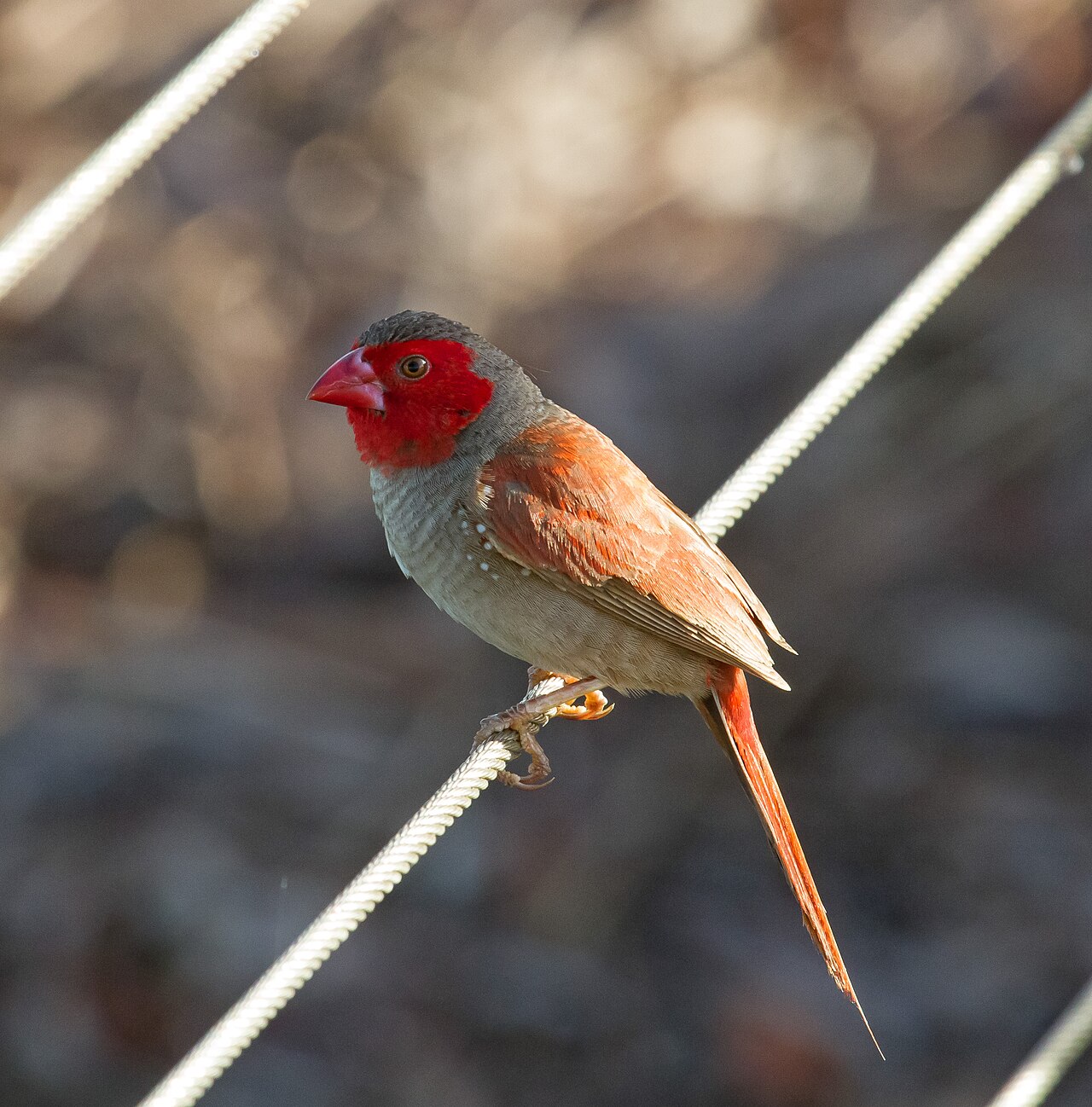
The Crimson Finch is the fiery red finch of the tropical north: a slim bird with a crimson face, crimson flanks and a long, tapering red tail, hardly ever found far from permanent water with pandanus. It is busy, noisy and decidedly pugnacious — a party on a creek bank in the Kimberley or the Top End is rarely quiet.
Voice
The call is a hard, metallic, slightly crackling chek or chet, often delivered in a rapid run of three to six notes on flushing or in a squabble; it is far sharper and louder than the call of the Red-browed Finch and carries across a creek bed. There is also a higher, thin contact note between feeding birds. The male's song is a soft, hoarse, hissing phrase of a few seconds, easily lost in the noise of a pandanus creek; it is given with the breast feathers raised and the body bobbing on a grass stem.
Recording: nick talbot — CC BY-NC-SA 4.0 · George Brown Darwin Botanic Gardens (near The Gardens), City of Darwin, Northern Territory, Australia · xeno-canto
Identification
A slim finch of twelve to fourteen centimetres, of which the long, pointed tail takes up almost half. The male has a deep crimson face, throat, breast and flanks, the flanks marked with a row of fine white spots, a grey-brown crown and nape, an olive-brown back and a bright red rump and tail; the belly is black in mainland birds and white in the form of Cape York Peninsula. The female is distinctly duller: the red is confined to face, rump and tail, the underparts are dull buff-brown and the centre of the belly pale. The bill is red in the breeding season, black outside it and in juveniles. Young birds are dull brown with a faint rufous wash on rump and tail. In flight what catches the eye is the long red tail streaming out behind.
Confusion species
Red-browed Finch (Neochmia temporalis) is the nearest relative and also shows red on the face, but there the red is limited to a sharp stripe over the eye while face, throat and flanks are grey; the tail moreover is short and dark instead of long and red, the back is olive-green, and the ranges barely meet — the Red-browed Finch belongs to the east and south-east, the Crimson Finch to the tropical north. Star Finch (Emblema ruficauda) likewise has a red face with white spots, but is olive-yellow below, has a much shorter tail and lives in drier grassy country without pandanus. Gouldian Finch (Chloebia gouldiae) is grass-green with a purple breast and yellow belly, and its red-headed form carries the red on the head rather than on throat and flanks. In the white-bellied form of Cape York the pattern is otherwise identical to that of the western birds.
Habitat
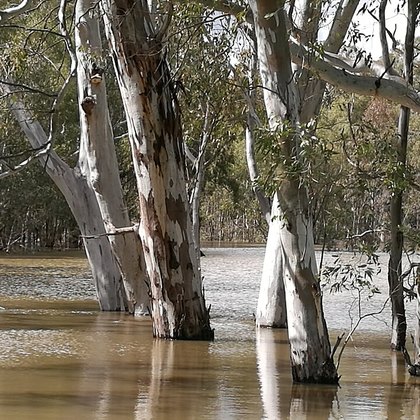
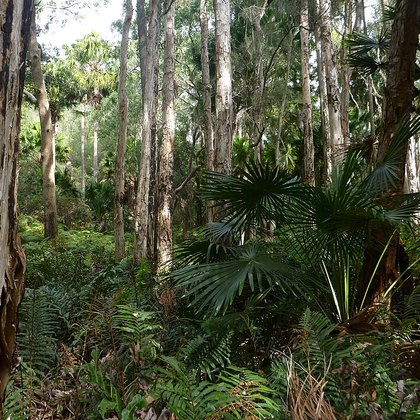
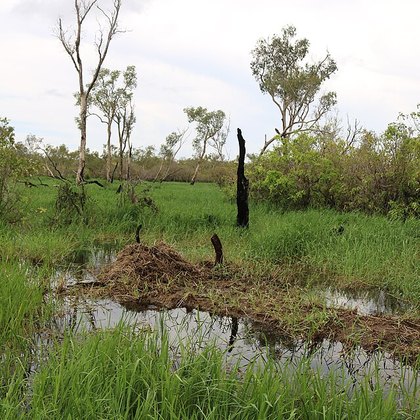
Strictly tied to permanent water in the tropics. The core is the narrow band of pandanus thicket, tall grass and reed along rivers, creeks and lagoons, where the species also nests: the bulky grass nest is built into the leaf axils of a pandanus or a palm, sometimes in a building or under an eave. It also uses melaleuca swamp, reed beds, grass round stock watering points, cane fields and gardens in towns such as Darwin and Kununurra, as long as water is near. Food is grass seed, supplemented with insects, taken on the ground or straight from the stem.
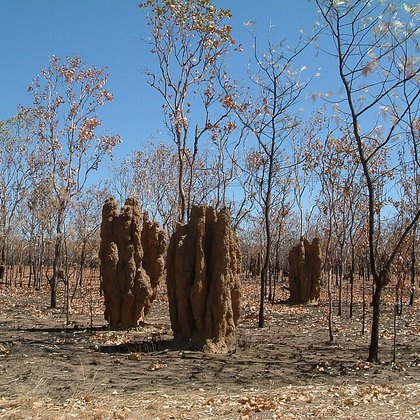
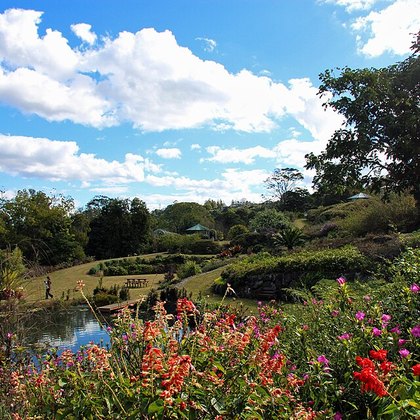
Where the bird is most often found, arranged by main group and formation.
Range and movements
The tropical north of Australia, from the Kimberley in northern Western Australia through the Top End of the Northern Territory to the Gulf country and northern Queensland. Within that the distribution is strongly linear: the species follows the watercourses and is absent from the dry country between them. On Cape York Peninsula lives the separate white-bellied form, which also occurs in southern New Guinea. There is no migration; birds stay by their watercourse all year, though they spread out a little in the wet season.
- Resident
- dark = core range, pale = thinly spread
Where and when to look
Find a creek or river bank with pandanus, stand back a little from the water and wait for movement in the leaves. The loudest, shortest rattle of the place is almost always this species: a sharp chek-chek-chek that recalls two pebbles knocked together. When you get a view, note whether the belly is black or white — that settles which of the two forms you have, and on Cape York it is worth the trouble.
Conservation
Globally the species is rated Least Concern (LC) and it is still locally numerous in the Kimberley and the Top End. The picture is not the same everywhere, though: because the bird depends entirely on a narrow strip of riparian vegetation, every damage to that strip hits it directly. Trampling of banks by cattle and feral water buffalo, burning of pandanus and reed fringes and altered water regimes have removed the species from large parts of Queensland; the white-bellied form of Cape York has declined sharply and is treated there as threatened. Conservation comes down to leaving the riparian strip intact.
Scientific name
Neochmia phaeton | (Hombron & Jacquinot, 1841)
Hombron and Jacquinot described the species in 1841 as Fringilla phaeton, from a bird taken at Raffles Bay in the Northern Territory. Because it has moved to another genus, author and year stand in parentheses. The epithet refers to Phaethon, the son of the sun god who in Greek myth was allowed to drive the sun chariot and set the earth ablaze — an allusion to the bird's fiery colour, which also sounds through in the Dutch name zonastrild, 'sun finch'. The genus Neochmia was erected by Gray in 1837. The English name Crimson Finch simply names the colour.