All species › Waders, gulls and terns › Skimmers, noddies, terns and gulls › Common Tern
Common Tern | Sterna hirundo
Visdiefje | Charrán común
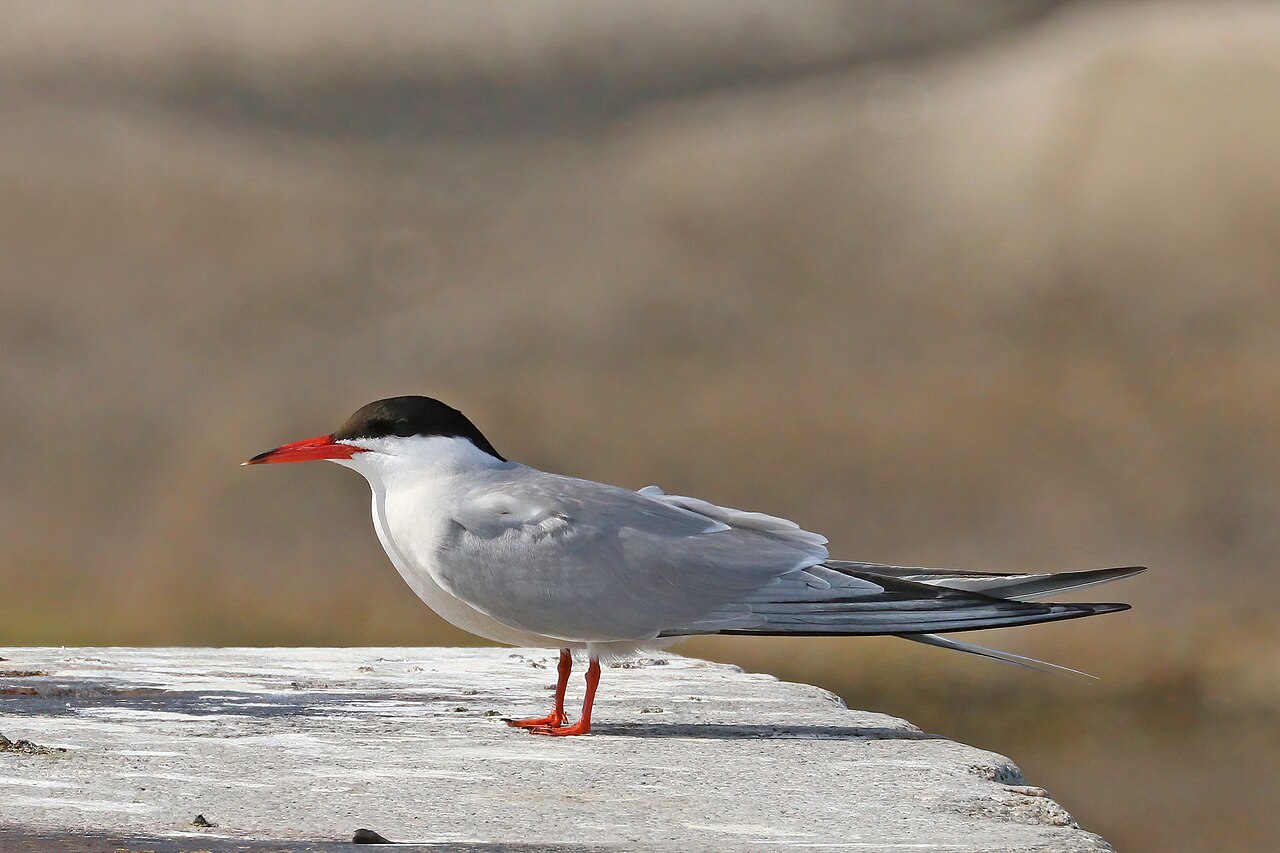
The Common Tern is not a breeding bird in Australia and New Zealand but a summer visitor from the north: between October and April small parties stand on sandbanks and harbour moles, usually among far larger Greater Crested Terns. Almost all the birds that reach here belong to the eastern subspecies longipennis from north-east Asia, and that race has a black bill and dark legs instead of the orange-red of the European plates. Anyone waiting for a red bill here waits in vain.
Voice
At a roost it is mostly silent, but on taking off it gives a hard, down-slurred keer-yah with the stress in front — the same alarm with which it defends its colony in the north. Between birds a short dry kip kip kip passes back and forth, especially when a party shifts from one sandbank to the next. Its voice is fuller and lower than that of the Arctic Tern. Here you hear it mainly at first light over an estuary, and rarely for long.
Recording: Lionel FREDERIC — CC BY-NC-SA 4.0 · Arrondissement de Vannes (near Sarzeau), Morbihan, Bretagne, France · xeno-canto
Identification
A medium-sized tern of a little over thirty centimetres, pale grey above and white to very pale grey below, with a deeply forked tail that at rest reaches the wingtips but does not pass them. In the plumage you almost always see here — non-breeding — the forehead is white, the black sits only as a cap over the hindcrown and nape, the bill is black, and a clear dark carpal bar runs across the bend of the wing. In flight the outer primaries darken into a broad, softly bounded wedge in the wingtip, more obvious as the plumage wears. The legs are short but not extremely so: a tarsus of 19.5 mm is a good sixth longer than the Arctic Tern's, and on a standing bird that shows.
Confusion species
Arctic Tern (Sterna paradisaea) is the hard one: visibly shorter-legged, with tail streamers passing the wingtips at rest, a translucent hand from below with a narrow, sharply drawn black trailing edge, and no dark carpal bar. White-fronted Tern (S. striata) is a size larger, much whiter, and carries a long all-black bill; in New Zealand it is the default tern and the Common Tern the exception. Black-naped Tern (S. sumatrana) of the coral cays instead has a white crown with a black nape band. Roseate Tern (S. dougallii) is paler, with long white streamers and a stiffer, shallower wingbeat. Greater Crested Tern (Thalasseus bergii), among which it usually stands, is the measuring stick: with its yellow bill and shaggy crest it stands a clear head above.
Habitat
Tidal flats, sandbanks and mud in estuaries and shallow bays, with harbour walls, groynes and jetties as roosts. It hunts by hovering over shallow inshore water, in the surf and over shoals of small fish just outside the break, and likes to work a tidal stream at a river mouth. Far offshore it is scarce here; this is a bird of the shoreline and the first few kilometres beyond it.
Where the bird is most often found, arranged by main group and formation.


Range and movements
October to April along the east and south coasts of Australia, most numerous in New South Wales, Victoria, Tasmania and South Australia, with passage along the Queensland coast and through Torres Strait. In New Zealand it is scarce but annual, chiefly in the Firth of Thames and in Manukau and Kaipara harbours. It breeds nowhere inside the map window: every bird here comes from Siberia, Mongolia or north-east China and returns in the southern autumn.
- Resident
- Breeding (summer)
- dark = core range, pale = thinly spread
Where and when to look
Work through a Greater Crested Tern roost at low tide and pick out the smaller, slimmer birds among them; a Common Tern gives itself away by the dark carpal bar and the black bill. February and March are the best months, when numbers peak and the first birds begin their spring moult, with the black creeping back onto the forehead. Check the wingtip of every party that lifts: a broad, softly bounded dark wedge is its signature.
Conservation
Least Concern (LC): worldwide this is a bird of millions, breeding across almost the whole northern hemisphere. Inside this map window there are no nests to protect, but there are roosts: a flock repeatedly flushed off a sandbank or a groyne by dogs, quad bikes or boats loses the rest it needs after a journey of ten thousand kilometres. Like other terns it is also caught in fishing line and swallows plastic.
Scientific name
Sterna hirundo | Linnaeus, 1758
Linnaeus described the species in 1758 as Sterna hirundo, and since it remains in that genus author and year carry no parentheses. Sterna goes back to Old English stearn, a word for tern already in the poem The Seafarer around the year one thousand. hirundo is Latin for swallow, after the forked tail and the light flight. The type locality is Europe, later restricted to Sweden. The birds of this region belong to the subspecies longipennis, described by Nordmann in 1835; longipennis means 'long-winged'. The Dutch name says what the bird does — it steals fish from the water — and the diminutive sets it apart from the larger terns.