All species › Waders, gulls and terns › Sandpipers and allies › Common Redshank
Common Redshank | Tringa totanus
Tureluur | Archibebe común
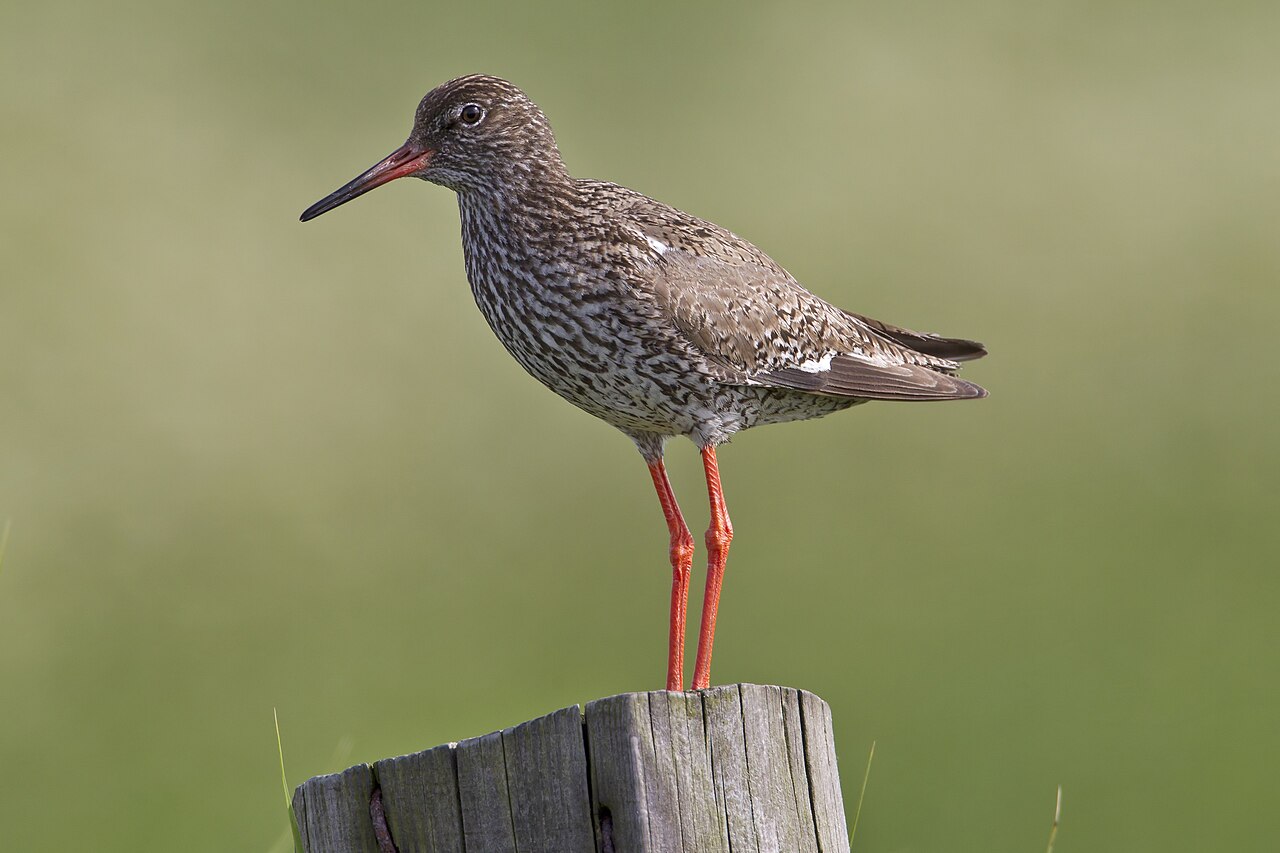
The Common Redshank is the commonest shank of the saltmarsh in Europe, but in Australia a rarity that listers will drive for: a medium-sized wader of nearly thirty centimetres with bright orange-red legs, a bill red at the base, and in flight two broad white trailing edges that fix it at a glance. It is noisy and watchful and puts a whole flat to flight.
Voice
The call is a loud, plaintive, ringing whistle that often runs on into a falling trill: tyuu-huu-huu, quickened when alarmed into a piercing tyu-tyu-tyu-tyu that carries the length of the flat. It is fuller and more plaintive than the clear three-note whistle of Common Greenshank and much lower than the sharp piping of Marsh Sandpiper. It is usually the first bird of a flock to lift and call, which in Europe has earned it the name of watchman of the marsh.
Recording: Vandousselaere Patrick — CC BY-NC-SA 4.0 · Arrondissement Brugge (near Brugge), West-Vlaanderen, Vlaams Gewest, Belgium · xeno-canto
Identification
A medium-sized, compact shank of twenty-seven to twenty-nine centimetres, plain grey-brown above and whitish below in non-breeding plumage, warmer brown with dark blotches and a finely streaked breast in summer. Two marks settle everything: the legs are orange-red, a duller orange in winter, and the straight bill is red over the basal half with a black tip. In flight it is unmistakable through the broad, pure white trailing edges to both wings, which travel with the bird as two pale bands, plus a white wedge running from the rump up the back. The legs project only slightly beyond the tail.
Confusion species
Common Greenshank (Tringa nebularia) is larger and paler, with yellow-green legs and an upturned bill without red, and lacks the white trailing edges entirely — that mark alone closes the case. Marsh Sandpiper (Tringa stagnatilis) is smaller and finer, with green legs and a needle bill. Wood Sandpiper (Tringa glareola) has yellow-green legs, heavily spotted upperparts and a square white rump with no white wing edges. On Common Sandpiper (Actitis hypoleucos) the white wing bar is narrow and set across the middle of the wing rather than broad along the trailing edge, and the legs are grey-green. Outside this group, a distant redshank can suggest a Ruff, but that bird has a smaller head, a short decurved bill and orange to pink legs without a red bill base.
Habitat
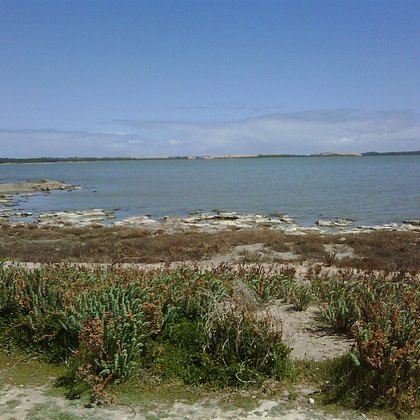
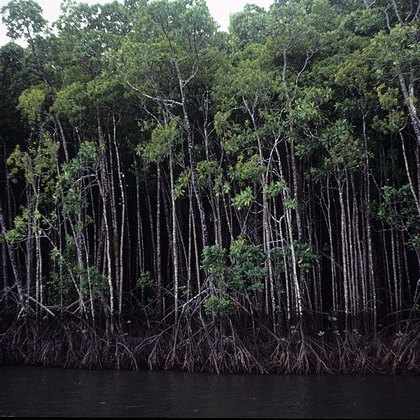
In the small number of Australian records, almost always the coast: intertidal mud and sandflats of large bays and estuaries, the edges of mangrove creeks, saltworks ponds and samphire (low, succulent saltmarsh shrubland on tidal mud) saltmarsh. It feeds walking on the mud, picking and probing shallowly, and roosts at high water among other waders on a sandbar or marsh edge. Inland it hardly appears here at all.
Where the bird is most often found, arranged by main group and formation.

Range and movements
A scarce but nearly annual visitor to northwestern Australia, centred on Roebuck Bay and the flats around Broome and on Darwin and the Top End coast; away from that corner any record is exceptional. Birds appear in the Australian spring and summer, roughly between September and March, usually as singletons among flocks of Common Greenshank and Bar-tailed Godwit. It does not reach New Zealand or Norfolk Island. The birds involved belong to the eastern subspecies, which normally winter in Southeast Asia and here overshoot the southern limit of their flyway.
- Resident
- dark = core range, pale = thinly spread
Where and when to look
Walk the high-tide roost at Roebuck Bay or on the Darwin flats and look at nothing but legs: among hundreds of green and grey pairs, one orange-red pair stands out at once. Then wait for the flock to lift, because the two broad white trailing edges are a mark no other shank here shows, and get the bird to call if you can — the plaintive tyuu-huu-huu makes the identification watertight.
Conservation
Least Concern (LC): the species breeds from Iceland into China and numbers hundreds of thousands of pairs worldwide. For this guide it is a rarity rather than a conservation case, though on the Asian arm of its range it does depend on the same intertidal flats around the Yellow Sea that are the bottleneck for the other waders of this flyway. In Europe it is genuinely under pressure, through drainage and intensification of the grassland in which it breeds.
Scientific name
Tringa totanus | (Linnaeus, 1758)
Linnaeus described the bird in 1758 as Scolopax totanus, with Sweden as the type locality; because of the later move to Tringa, author and year stand in parentheses. The epithet totanus is not classical Latin but a borrowed folk name: tótano, the Italian word for this bird. The genus name Tringa goes back through Neo-Latin to Aristotle's trungas. The English name, like most European names, refers to the red legs; the Dutch name tureluur is onomatopoeic and renders the falling three-note call.