All species › Gamebirds › Partridges, pheasants, grouse and allies › Common Pheasant
Common Pheasant | Phasianus colchicus
Fazant | Faisán vulgar
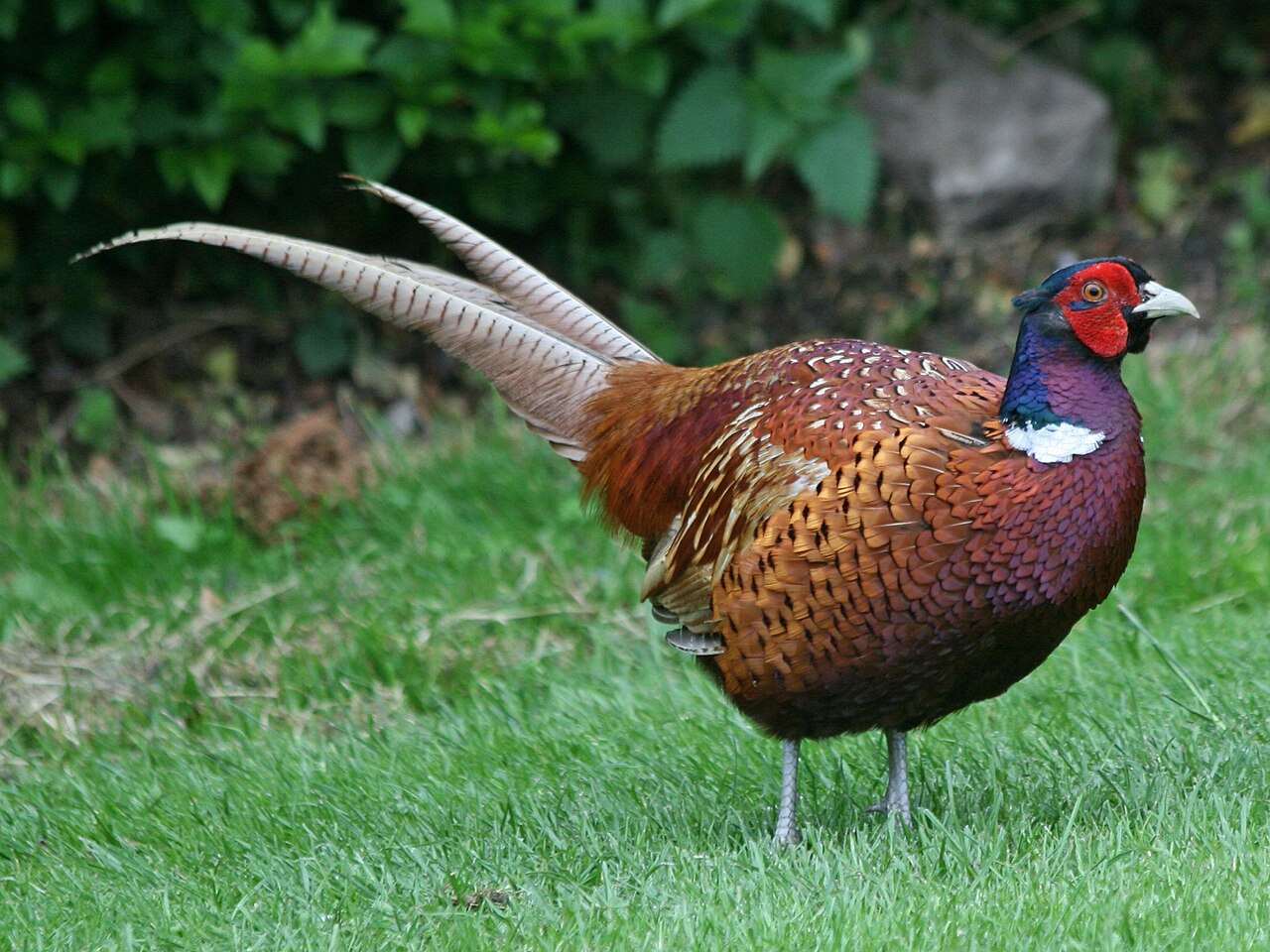
The Common Pheasant is the largest introduced gamebird in the guide area, and in New Zealand no rarity at all: the male, with his green-glossed head, red facial wattles, white neck ring and long barred tail, is unmissable from a farm road. In Australia, by contrast, it amounts to a handful of small island populations. Everywhere in the region it was let loose for shooting, and nowhere does it belong.
Voice
The male crows a loud, hoarse, two-part kok-kok, often rounded off with a short drumming of the wings; it is the sound that carries across farmland at first light and usually the first sign of him. Disturbed, he gives a loud throaty alarm, korrrk, frequently at the moment he clatters up out of cover. The female is far quieter and at most gives a soft peeping note.
Recording: Jens Schöller — CC BY-NC-SA 4.0 · Straubing-Bogen (near Kirchroth), Lower Bavaria, Bavaria, Germany · xeno-canto
Identification
The male reaches eighty centimetres including the tail and is unmistakable: head and neck metallic blue-green, a bare red face with wattles and two small ear tufts, usually a white neck ring, and a body of copper and golden brown in which every feather carries fine black marking and a pale edge. The tail is very long, pointed and sharply barred. The female reaches sixty centimetres, is plain sandy brown with fine dark spots and streaks, and has a much shorter but still pointed tail. Both flush explosively with a loud clatter, then glide away low for a long way.
Confusion species
Wild Turkey (Meleagris gallopavo), feral in New Zealand and on some Australian islands, is far bigger and heavier, with a broad fanned tail and a bare blue-red head without ear tufts. Helmeted Guineafowl (Numida meleagris) is grey with white spots, has a bony casque on the head and a short drooping tail. Red Junglefowl (Gallus gallus) is smaller, with a red comb and sickle-shaped tail feathers. The female is the difficult one: a brown streaked gamebird in the grass is almost always a hen pheasant if the tail is long and pointed; in turkey and guineafowl hens it is short and blunt.
Habitat
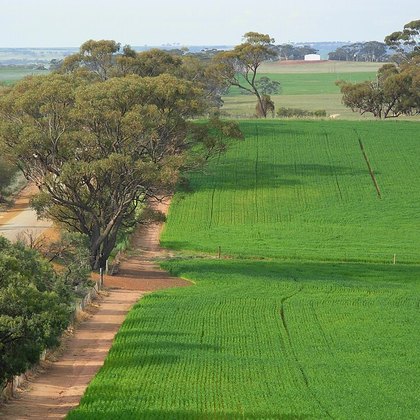
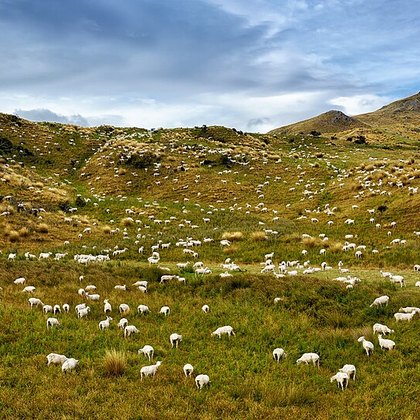
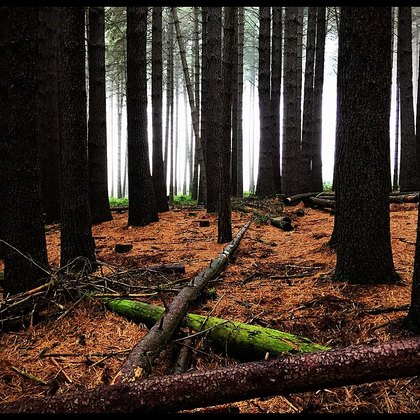
Open, varied farmland: arable, pasture with hedgerows and ditches, road verges and the edges of exotic forestry, always with rough growth or scrub within walking distance to disappear into. In New Zealand it also uses coastal dune and coastal shrubland and deciduous copses around farms, and it is markedly attached to ground where ink weed grows. It avoids closed native forest and bare, uniform pasture without cover alike. On the Australian islands it keeps to low scrub and dune thicket around the settlements.
Where the bird is most often found, arranged by main group and formation.
Range and movements
In New Zealand it is commonest in the northern and western North Island, with an estimated population of around two hundred and fifty thousand birds; in the South Island chiefly in the drier parts of Canterbury and Nelson. It is absent from Norfolk Island. In Australia it does not hold on across the mainland: the established populations are on islands, above all Rottnest Island off Perth, where it settled around 1928, and King Island in Bass Strait; what walks about elsewhere comes from recent gamebird releases and usually fades away again.
- Resident
- dark = core range, pale = thinly spread
Where and when to look
Drive a back road in Northland or the Waikato at sunrise and stop at every verge of long grass: the crowing gives the cock away before you see him, and he often walks right alongside the tarmac. After the late-summer cut whole families work the stubble. If a bird is flushed, watch the flight: explosive, clattering, then a long flat glide on stiff wings — no other gamebird in the region does that.
Conservation
Least Concern (LC) globally, and thoroughly established in New Zealand. The history begins between 1842 and 1877, when the acclimatisation societies released birds near Wellington, Canterbury, Otago and Auckland to give European colonists something to shoot. Numbers climbed fast, then collapsed in the 1890s when stoats and ferrets were let loose against the rabbits and poisoned grain was laid on a large scale at the same time. Since then the population has held, helped by captive-bred birds released every year. As an exotic it enjoys no protection; it is hunted, and the concern is not its survival but what it takes in seed and invertebrates and what diseases it carries.
Scientific name
Phasianus colchicus | Linnaeus, 1758
Linnaeus described the species in 1758 in the tenth edition of his Systema Naturae as Phasianus colchicus, and it has stayed in that genus, so author and year carry no parentheses. Both names point to the same country: Phasianus comes from Greek phasianos, 'bird of the Phasis', the river now called the Rioni, running through Georgia to the Black Sea, and colchicus means 'of Colchis', the ancient land on that same river — the country of the Argonauts, from which the bird was by tradition carried back to Greece. The type locality is accordingly the lower Rioni. The birds of Australia and New Zealand are no pure race but a mixture of European and Chinese stock, which is exactly why one cock carries a white neck ring and the next does not.