All species › Pigeons and doves › Doves and pigeons › Common Bronzewing
Common Bronzewing | Phaps chalcoptera
Bronsvleugelduif | Paloma bronce común
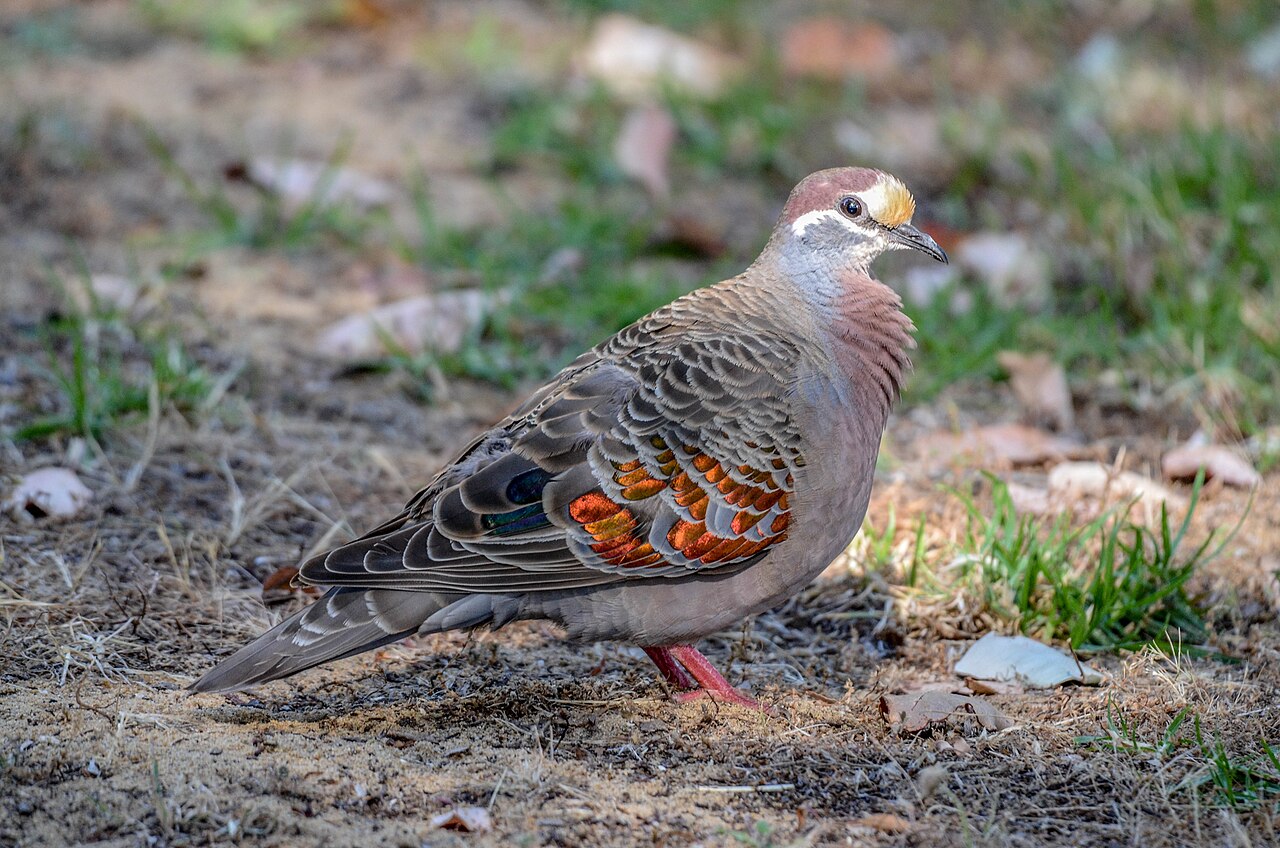
The Common Bronzewing is Australia's most widespread large ground pigeon and turns up in almost every landscape except the barest and the densest rainforest. At range it looks a dull earth brown, but the moment sun strikes the folded wing, oval panels light up there in green, blue and copper-red — the character the whole group is named for.
Voice
A deep, heavy and perfectly regular oom, repeated at intervals of a few seconds for long stretches, like a metronome left running in the bush. The note is so low it is hard to place, and at close range seems felt rather than heard. Take-off is a loud clatter, after which the bird drives away low and fast across the ground.
Recording: Stephen Bushell — CC BY-NC-SA 4.0 · R.D.Egan Lee Reserve, Knoxfield, Victoria, , Australia · xeno-canto
Identification
A stout, heavily built pigeon of thirty to over thirty-five centimetres, olive to earth brown above with fine scalloping and greyish below. A sharp white line runs below and around the eye. The male has a yellow-white to cream forehead and a pink-washed breast; the female is duller and greyer on the head. Across the folded wing lie irregular, blocky panels that flare green, blue or copper-red according to the light. Young birds are browner and still lack almost all the metallic sheen.
Confusion species
Brush Bronzewing (Phaps elegans) is the hard one: smaller and darker, with a rich chestnut nape and shoulder, a dark stripe straight through the eye underlined in white, and a chestnut throat patch — none of which the Common Bronzewing has, showing instead the continuous white eye line and, in the male, a pale yellow forehead. The wing panels of elegans also sit as two neat curved bars across the wing, whereas here they are scattered irregularly. Flock Bronzewing (Phaps histrionica) is the same size but sandy-coloured with a sharply drawn black-and-white head, lives in flocks on flat inland grassland and barely overlaps in habitat. Crested Pigeon (Ocyphaps lophotes) also carries bronze wing panels but is slimmer, grey and wears a thin upright crest.
Habitat
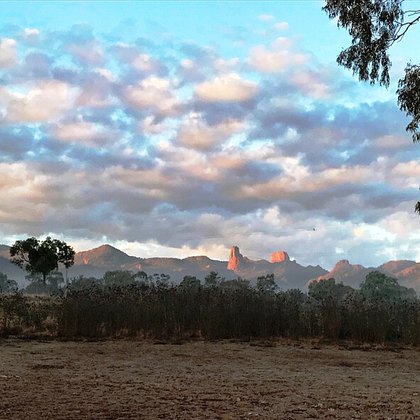
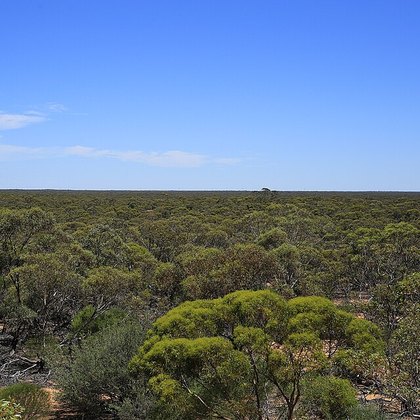
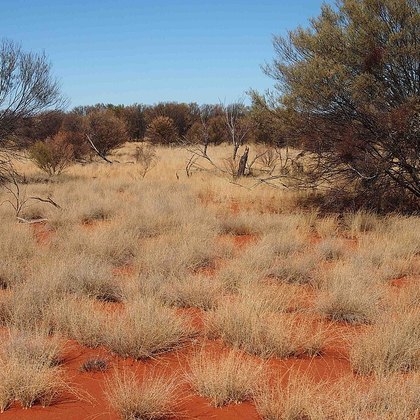
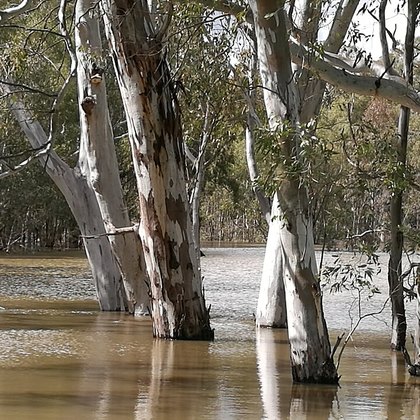
Almost everything except the barest desert and closed rainforest: dry eucalypt forest and woodland, mallee (low, multi-stemmed eucalypt scrub of dry southern Australia), mulga (acacia scrub of the dry interior, dominated by Acacia aneura) and acacia scrub, riverine woodland along creeks, heath, crop margins and roomy outer-suburban gardens. The one firm requirement is drinking water within reach — it comes in to it by day or night and rarely stays far from a watering point.
Where the bird is most often found, arranged by main group and formation.
Range and movements
Virtually all of Australia, from the south-west corner to Cape York and from the coast far inland, including Tasmania and many coastal islands; only the driest sand deserts and the wet tropical rainforests stay empty. It is one of the most numerous pigeons on the continent. It does not occur in New Zealand.
- Resident
- dark = core range, pale = thinly spread
Where and when to look
At sunrise or in the last hour of the day, sit by a stock trough, a dam or a creek pool in dry woodland: the birds come in to drink in small parties, nearly always at the same hour and the same spot. With a perched bird, work round the sun yourself rather than closing the distance, because the wing panels only appear at the right angle.
Conservation
Least Concern (LC), and of all Australian pigeons one of the best placed. The species has in fact gained from pastoralism: dams, troughs and bores have put permanent water into country that formerly held none year-round, so its range in the dry interior has widened rather than shrunk. Locally feral cats and foxes press on numbers and clearing removes habitat, but at continental scale that does not outweigh its adaptability.
Scientific name
Phaps chalcoptera | (Latham, 1790)
John Latham described the species in 1790 as Columba chalcoptera, so author and year stand in parentheses now the bird sits in Phaps. That genus was introduced in 1835 by Prideaux John Selby, with this species as its type; phaps is the Ancient Greek word for a wild pigeon. The epithet chalcoptera is built from khalkos 'bronze' and pteron 'wing' and describes the glossy panels exactly. The type bird comes from New South Wales.