All species › Passerines › Logrunners › Chowchilla
Chowchilla | Orthonyx spaldingii
Zwartkopraltimalia | Colaespina de Spalding
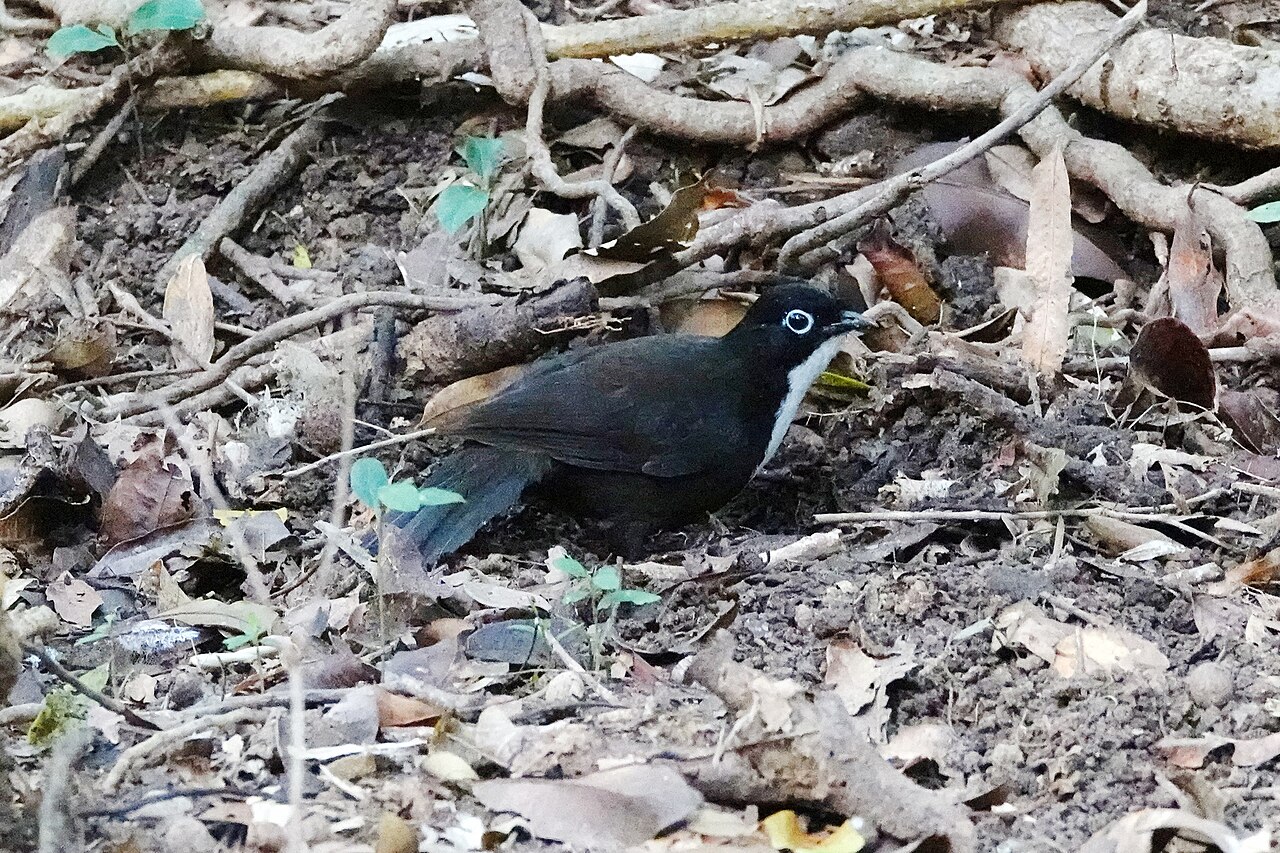
The Chowchilla is the large, loud ground bird of the rainforest of the Wet Tropics in north-eastern Queensland. It is heavy and dark, with a black head, a conspicuous pale eye-ring and a throat that is white in the male and orange-brown in the female. You hear it before you see it: at first light a family party bursts into a raw, far-carrying chorus that gave the bird its name.
Voice
The sound is the most characteristic feature of the species. At dawn a group strikes up a loud, rolling, clattering chorus rendered chow-chilla-chow-chowry-chook-chook — the source of the English name. It is hoarse, starts without warning, runs for half a minute and stops as abruptly. Through the day there are short, hard contact notes and a sharp rattling alarm when a party is scattered. In closed rainforest the chorus carries for hundreds of metres and is often the first thing a visitor to this forest hears.
Recording: J.V. Moore — CC BY-NC-SA 4.0 · Queensland: Cape York Peninsula: Daintree NP, Australia · xeno-canto
Identification
Twenty-six to twenty-nine centimetres and solidly built: at nearly a hundred and fifty grams the heaviest songbird of the rainforest floor in the Wet Tropics. The head is blackish, the upperparts dark olive-brown, and a broad, pale blue-white ring surrounds the eye and catches what little light reaches the forest floor. Throat and breast are white in the male and orange-brown in the female — one of the few cases in this group where you can sex a bird in the field. The tail feathers are stiff and end in bare, spiny shafts; the bird props itself on them while working the litter. It flies seldom and heavily, and would rather walk away.
Confusion species
Australian Logrunner (Orthonyx temminckii), the only other member of this family in the guide, is the obvious confusion, but range settles it: that species lives in the south-east, from Noosa to Nowra, a good thousand kilometres further south, and is besides much smaller, brown rather than black-headed, and marked with white wing bars. Within the Wet Tropics themselves the Bassian Thrush (Zoothera lunulata) is the bird it may be confused with on the ground, but that one is scalloped and forages alone and silently, not in a calling party. Fernwren (Oreoscopus gutturalis) and Atherton Scrubwren (Sericornis keri) share the litter layer but are barely a third the size. A large, dark, calling flock bird sweeping leaves aside with its feet on the floor of tall rainforest in north-eastern Queensland is this species.
Habitat
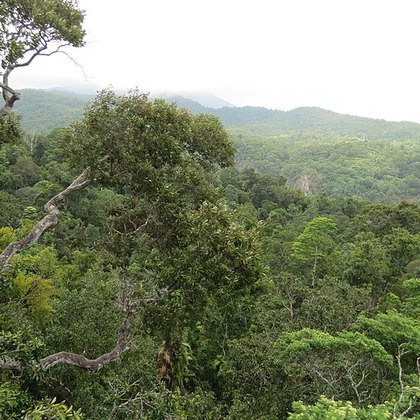
The floor of closed tropical rainforest, from the lowlands to the highest tablelands, with most birds above about three hundred metres where the forest stays wet and the litter deep. It works the leaf layer methodically: standing on its stiff tail it sweeps leaves sideways with one foot and leaves bare, round patches that are a visiting card in the forest long after the bird has gone. Food is insects, centipedes, snails and worms. It lives in family parties that hold together all year and defend a fixed territory, and builds a large domed nest of moss and twigs low against a trunk or among buttress roots.
Where the bird is most often found, arranged by main group and formation.
Range and movements
Confined to the rainforest of the Wet Tropics in north-eastern Queensland, from the Big Tableland near Cooktown in the north south to the Paluma Range near Townsville. Within that it is locally common — the Atherton Tableland, Mount Lewis, the Palmerston Highway and Paluma are well-known places. It is sedentary in the strictest sense: it does not migrate, does not wander, and will not cross open ground between two blocks of forest. That makes the forest itself the boundary of the range.
- Resident
- dark = core range, pale = thinly spread
Where and when to look
Come early. The dawn chorus, in the first half-hour after sunrise, is by far the most reliable way to record the species and often the only one. Then walk a rainforest track slowly and watch the ground: the bare, swept patches in the litter tell you a party has passed. Stand still the moment you hear rustling — the birds sometimes come within a few metres, but they walk away as soon as you move. No torch or flash is needed; patience and a place to do nothing for a while are.
Conservation
Least Concern (LC). The forest it lives in is World Heritage and no longer logged, and within that forest it is common. The vulnerability lies in the confinement: one continuous but not very large block of rainforest, a bird that will not cross open ground, and a need for a thick damp litter layer. Cyclones that open the canopy and feral pigs that turn the floor over are the two things that reach the litter layer; in the long term the warming of the Wet Tropics is the concern.
Scientific name
Orthonyx spaldingii | Ramsay, 1868
Ramsay described the species in 1868, originally as Orthonix spaldingii, for Edward Spalding, a Queensland collector and taxidermist who supplied the type material. Orthonyx is formed from Greek orthos (straight) and onyx (claw), after the long straight hind claw these birds work the litter with. The English name Chowchilla is onomatopoeic and comes straight from the dawn chorus. The Dutch name cites the black head; the family Orthonychidae holds three species in all, this one, the Australian Logrunner of the south-east and a third in New Guinea.