All species › Waders, gulls and terns › Skimmers, noddies, terns and gulls › Caspian Tern
Caspian Tern | Hydroprogne caspia
Reuzenstern | Pagaza piquirroja
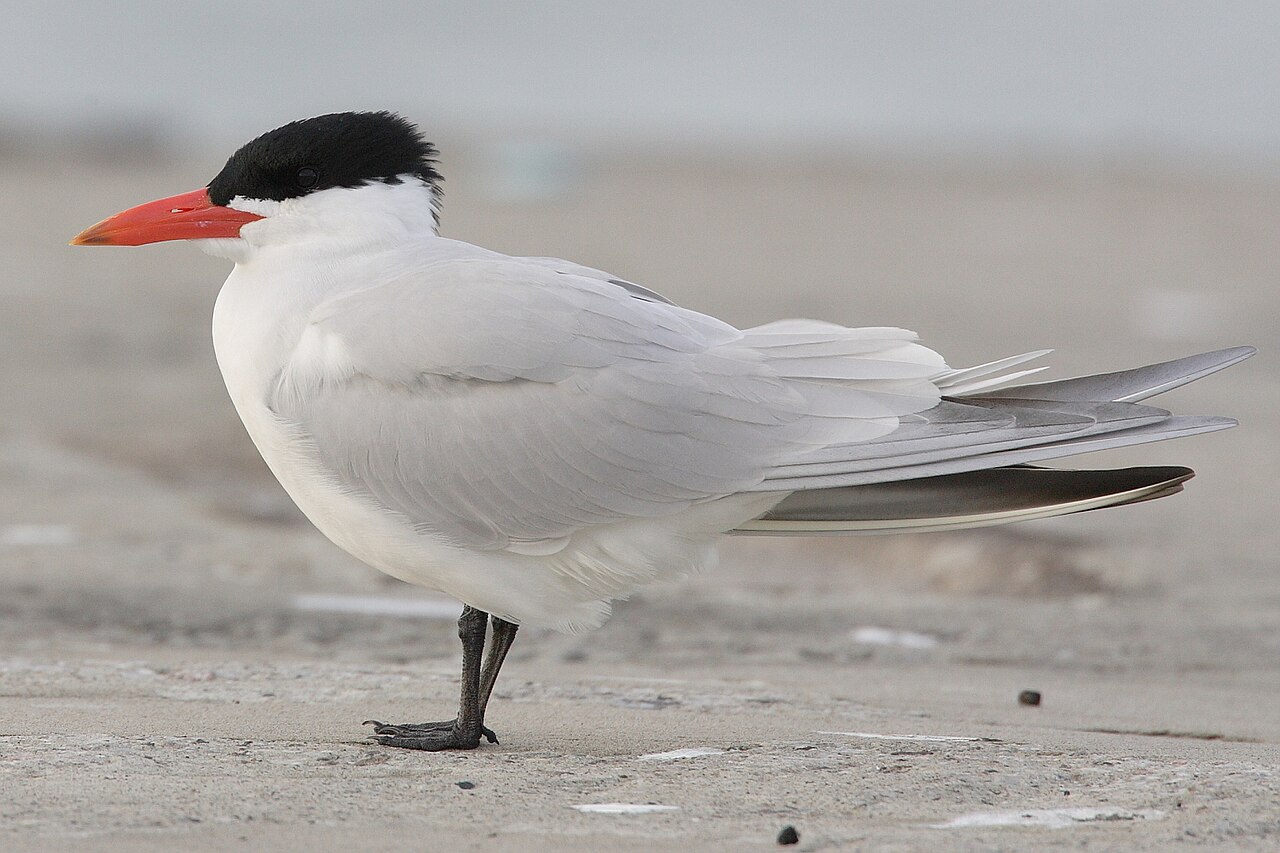
The Caspian Tern is the largest tern in the world: a bird the size of a big gull, with a heavy coral-red bill carried ahead of it like a dagger. In this guide it is the yardstick for every other tern — once you know this bulk and this bill, you can measure every other tern against it. In Australia and New Zealand you meet it on tidal flats and equally hundreds of kilometres inland on a lake.
Voice
The call is a deep, hoarse, far-carrying kraah, more the croak of a heron than the shrill note of a tern; two or three birds over a nesting bank already sound like an argument. In alarm it becomes a short raw series, ra-ra-ra. Young birds beg with a thin plaintive wee-yoo that goes on for months: in midwinter, far from the colony, you can still hear a full-grown youngster calling after its parent.
Recording: Julien Bottinelli — CC BY-NC-SA 4.0 · Mouroux, Seine-et-Marne, Île-de-France, France · xeno-canto
Identification
A heavy, broad-winged tern approaching half a metre, with a wingspan over a metre and a half and a weight around six hundred and fifty grams — heavier than a Black-headed Gull. The body is white with pale grey upperwings; the bill is thick, coral-red and usually tipped dusky. In breeding plumage the crown is jet black to below the eye, and unlike almost every other tern that cap never turns truly white out of season: at most it becomes black streaked with white. The legs are black, the tail short and only shallowly forked. From below the outer primaries are strikingly dark grey, a mark that survives even against the light. The flight is slow and gull-like; it searches with the bill pointed straight down and dives with a heavy splash from ten to thirty metres up.
Confusion species
Within this region no second tern comes close: size alone settles it. Greater Crested Tern (Thalasseus bergii) is nearest in length but clearly lighter in build, with a slimmer lemon-yellow bill, a shaggy black crest on the nape, a white forehead all year and a more deeply forked tail. Lesser Crested Tern (Thalasseus bengalensis) is smaller again and orange-billed. Australian Tern (Gelochelidon macrotarsa) also carries a heavy bill, but a jet-black and far shorter one, and the bird is a third smaller. At distance, and certainly resting among gulls, a Caspian Tern is sometimes taken for a gull; the straight red bill, the black cap reaching below the eye and the head-down searching flight then decide it.
Habitat
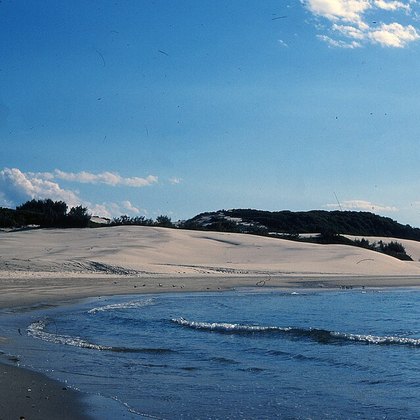
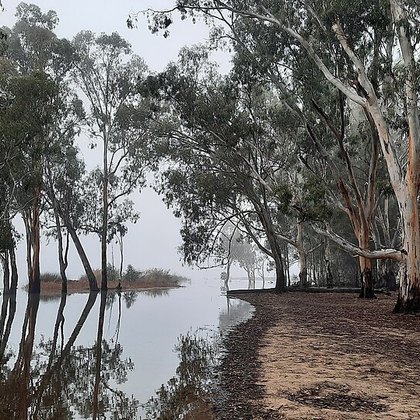
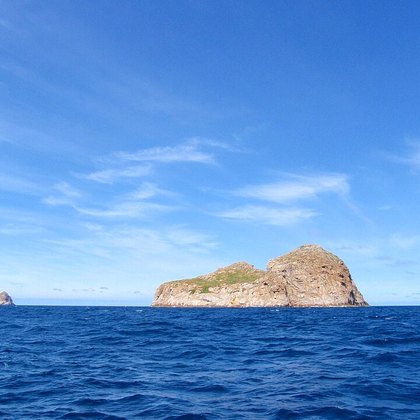
Shallow, sheltered salt and brackish water: estuaries, harbours, coastal lagoons, shellbanks and sandflats, which are also where it nests. Unlike most terns it goes just as readily inland, to large lakes, reservoirs and the wide shingle beds of the Canterbury braided rivers. It nests on bare shell grit or sand, usually on an islet or a spit that stays dry at high water.
Where the bird is most often found, arranged by main group and formation.


Range and movements
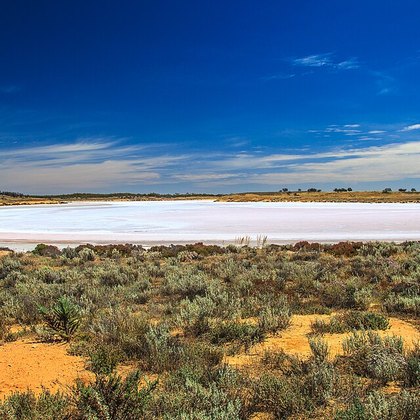
In Australia around nearly the whole coast, commonest in the southeast, around the Gulf of Carpentaria and along the South Australian gulfs, with outliers far inland: after good rain it breeds on the salt lakes of the Lake Eyre basin. In New Zealand it breeds on both the North and South Islands, with strongholds at Kaipara Harbour, the Firth of Thames, the Bay of Plenty, Tasman Bay and the Canterbury river plains; the national population runs to roughly one to one and a half thousand pairs, one of the smaller tern populations of the country. Outside the breeding season, young birds in particular wander along the coast.
- Resident
- Breeding (summer)
- dark = core range, pale = thinly spread
Where and when to look
Look for it at the high-tide roost: standing on a shellbank or sandflat among the gulls it is head and shoulders above them, and the red bill shows through a telescope across a kilometre of mud. Then look at the birds beside it — a brownish scaly bird begging alongside is its chick of that season, however long it has been flying.
Conservation
Least Concern (LC) globally, with a broad and stable range across five continents. Locally the picture differs: because it nests on open sand and shell banks, its colonies are unusually sensitive to disturbance by walkers, dogs and beach vehicles, and a single flush on a hot day already costs eggs. Add predation by rats, stoats and gulls, and nests drowned by storm surge or a river in flood. In New Zealand the species is therefore rated nationally vulnerable despite its comfortable global status.
Scientific name
Hydroprogne caspia | (Pallas, 1770)
Pallas described the species in 1770 as Sterna caspia; because it was later moved to another genus, author and year stand in parentheses. The genus Hydroprogne was introduced by Kaup in 1829 and is built from Greek hudro-, 'water', and Latin progne, 'swallow' — the water swallow, the image Latin often uses for terns. caspia refers to the Caspian Sea, where the described specimen came from; that a bird breeding on five continents is named after one inland sea is among the happier accidents in tern naming. The Dutch name, 'giant tern', simply says what you see; the Maori name taranui means simply 'big tern'.