All species › Tubenoses › Petrels, shearwaters and diving petrels › Buller's Shearwater
Buller's Shearwater | Ardenna bulleri
Buller-pijlstormvogel | Pardela de Buller
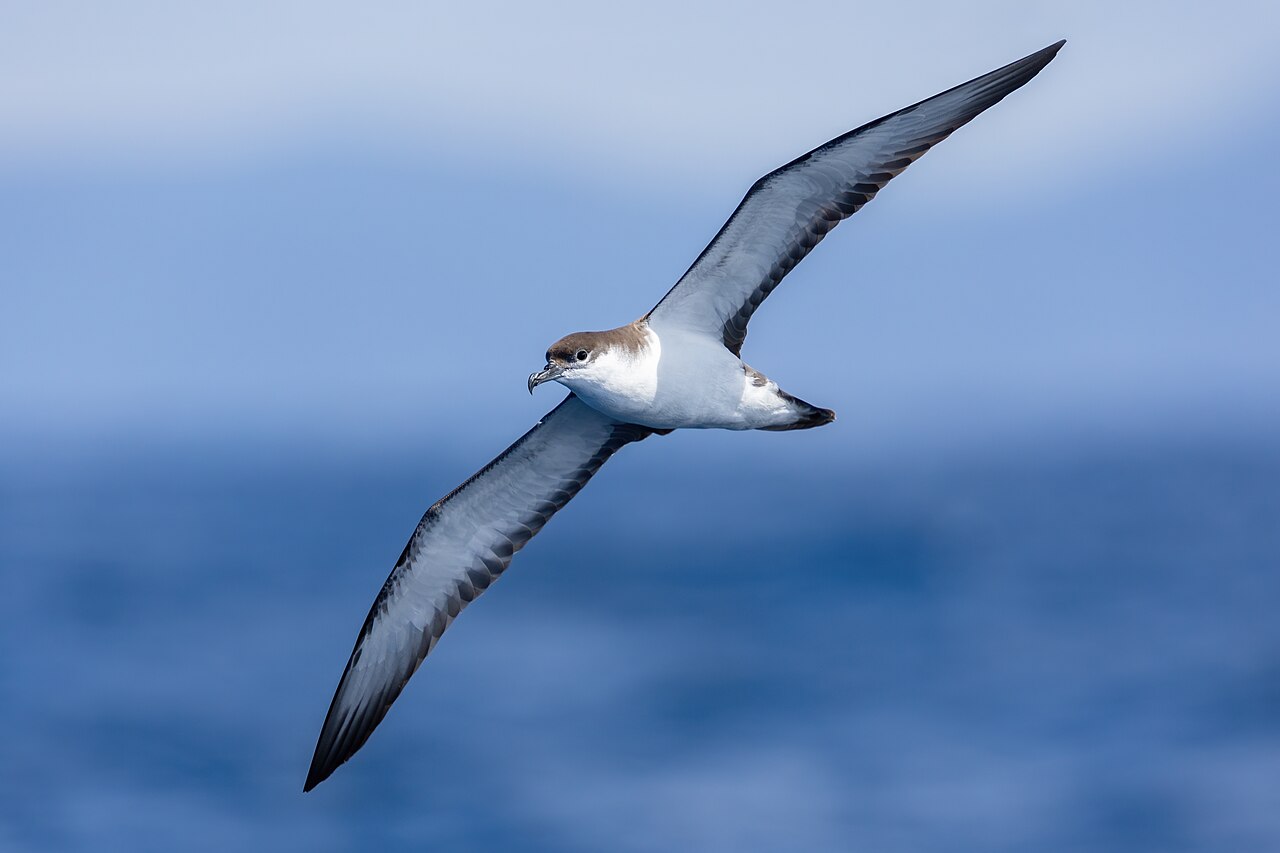
Buller's Shearwater is grey-brown above with a sharp dark M across wings and back, clean white below including the underwing, and with a neat dark cap ending just under the eye above a white cheek. It breeds only on the Poor Knights Islands off Tutukaka, and nowhere else on earth.
Voice
At sea it is silent. In the colony at night comes a sound much like Sooty Shearwater's: wailing, cooing and groaning notes from the burrows and among the rocks, with sharp yelps when nest sites are disputed. By day the breeding ground is quiet — the birds come in only after dark.
Recording: Sophie Bennett — CC BY-NC-SA 4.0 · Whangarei District, Northland, New Zealand · xeno-canto
Identification
Forty-six centimetres and about four hundred and twenty grams, slim in build, with long narrow wings and a long, tapering dark tail. The upperparts are grey-brown with darker flight feathers and primary coverts that together form a sharp blackish-brown M from wingtip across the back to the other wingtip. The crown is dark brown and runs to just below the eye, giving a clear cap with a white cheek beneath it. The whole underside is white, underwing included, which shows at range as uniformly white. The bill is grey-black with a sharp hook and measures thirty-eight to forty-five millimetres. Flight is light, in long glides with few beats.
Confusion species
Great Shearwater (Ardenna gravis), a vagrant here, also has a dark cap, but with a white collar behind it, a dark belly patch, a scalloped mantle and a white horseshoe above the tail — all four missing in Buller's. Wedge-tailed Shearwater (Ardenna pacifica) is more uniformly dark above with no M and has a slate bill. The small Pterodroma petrels, such as Cook's Petrel (Pterodroma cookii), also carry an M across the upperwing, but are far smaller, short-billed and shorter-tailed and fly in high tumbling arcs instead of long level glides. The grey back with its M, plus the long dark tail, plus the wholly white underwing come together in this species alone.
Habitat
Open sea over the continental shelf and along its edge, in the breeding season often in the lee of the north-east coast of the North Island and over shallows where food is driven to the surface. It feeds just under the surface, at most a head's length down. It breeds in burrows it digs in forest soil and under ferns on steep island slopes.
Where the bird is most often found, arranged by main group and formation.
Range and movements
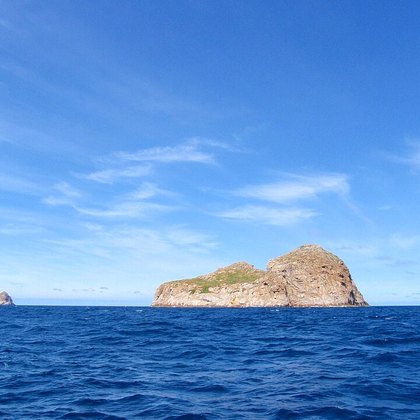
The only breeding site in the world lies on the Poor Knights Islands off Tutukaka in Northland: Aorangi and Tawhiti Rahi. From October to April it is therefore numerous off the north-east coast of the North Island and in the Hauraki Gulf, where hundreds can feed together, and it also occurs in Cook Strait and along the east coast of Australia, where it is a regular guest on pelagic trips out of New South Wales. At Norfolk Island it is rare. Outside the breeding season it leaves this map window altogether, crossing the equator to the North Pacific east of Japan and returning down the west coast of North America and across the mid-ocean.
- Breeding (summer)
- dark = core range, pale = thinly spread
Where and when to look
The classic option is a boat trip from Tutukaka to the Poor Knights themselves, or a pelagic out of the Hauraki Gulf between November and March; off Wollongong and Sydney it is the most sought-after shearwater from January to April. Look for a slim, pale shearwater sailing low over the swell on long wings, and watch for the dark M: that pattern gives it away before cap or underwing can be judged.
Conservation
Vulnerable (VU), not because it is scarce — the world population is put at some two and a half million birds — but because it puts everything on one square: outside the Poor Knights it breeds nowhere, so one introduced rat, one fire or one oil spill reaches the whole species. The history shows how fast that can go: feral pigs had cut the Aorangi colony to a hundred or two hundred pairs by the late 1930s. After the pigs were removed in 1936 the population grew back, to two hundred thousand pairs by the early 1980s. Beyond that weigh oil pollution — at least a hundred and fifty-six died in the 2011 Rena spill — and fisheries bycatch.
Scientific name
Ardenna bulleri | (Salvin, 1888)
Salvin described the species in 1888 as Puffinus bulleri; because it was later placed in another genus, author and year go in parentheses. The genus Ardenna was set up by Reichenbach in 1853, with Great Shearwater as its type species. The specific name honours Walter Lawry Buller, the nineteenth-century New Zealand lawyer and ornithologist whose standard work on the birds of New Zealand made him the authority in that field. The type locality is simply New Zealand. The Maori name is rako.