All species › Passerines › Honeyeaters › Bridled Honeyeater
Bridled Honeyeater | Bolemoreus frenatus
Bontbekhoningeter | Mielero embridado
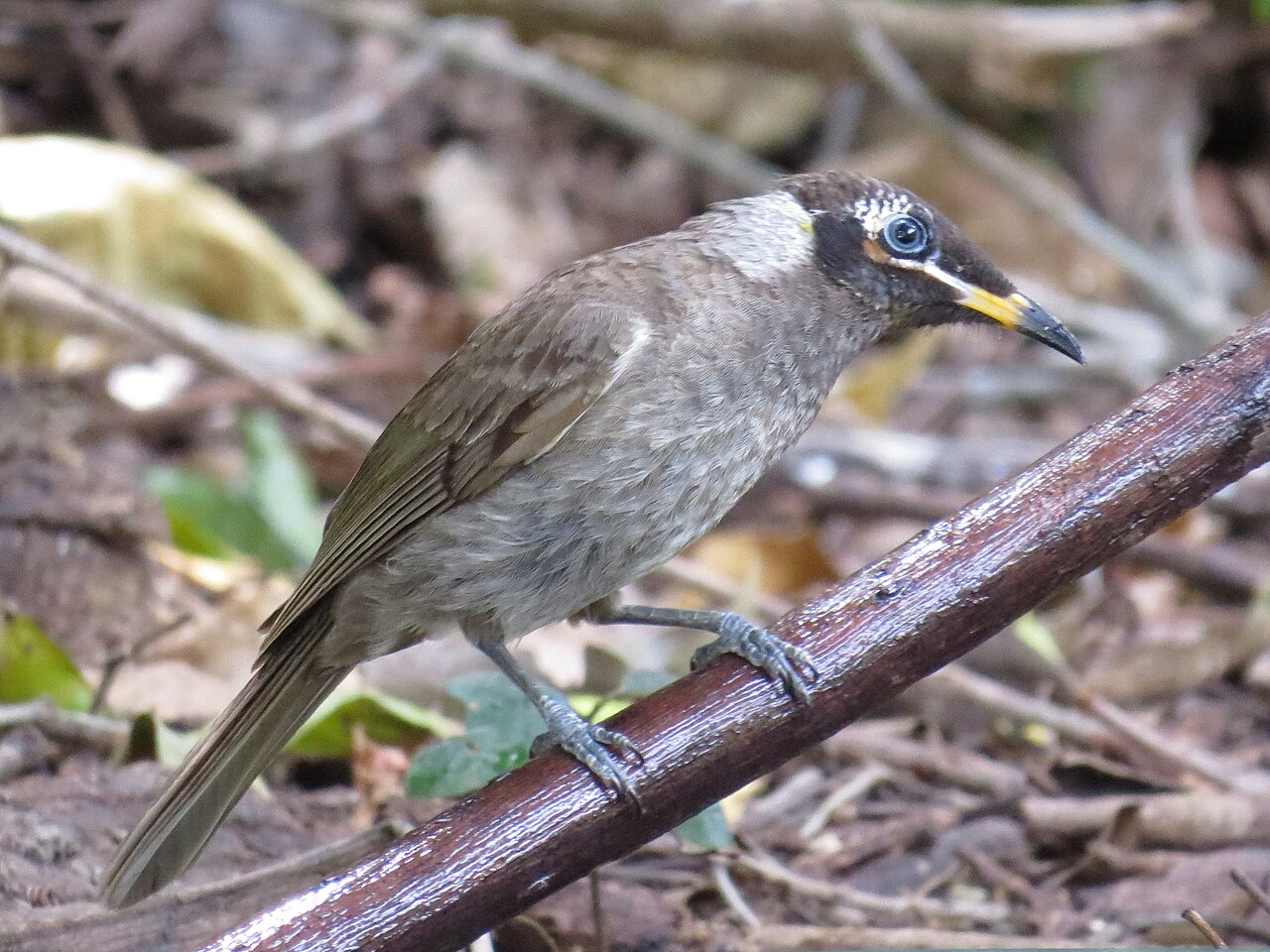
The Bridled Honeyeater is the noisy honeyeater of the mountain rainforest of tropical north-east Queensland, and it occurs almost nowhere else. It is dark dusky brown to grey-brown, with a blue iris, a white gape stripe, a yellow ear tuft and a large whitish patch on the side of the neck. The feature that names it is the bill: black at the tip, yellow at the base. Wherever a tree flowers or fruits it gathers in loud, quarrelsome parties; otherwise it is solitary and unobtrusive.
Voice
Loud, nasal and penetrating, and in the dense canopy usually the first sign that the species is present. The territorial song is a series of sharp, clear, far-carrying notes; between them comes continuous squabbling — harsh, yapping and rattling calls with which the birds drive one another off a flowering branch. A party at a flowering tree produces an almost unbroken din audible through the forest from tens of metres away. Anyone looking for the species listens first and looks up afterwards.
Recording: Meena Haribal — CC BY-NC-SA 4.0 · Danbulla, Tablelands Regional, Queensland, Australia · xeno-canto
Identification
A medium to large honeyeater of twenty to twenty-two centimetres, dark dusky brown to olive-grey on head and back, paler grey-brown below. The features are all on the head: a grey-blue to blue iris, a yellow mark below it and a small white one behind it, a yellow ear tuft, a conspicuous white gape stripe running back from the base of the bill like a bridle, and a large whitish to grey-white patch on the side of the neck. The bill is slightly decurved, black over the front half and yellow at the base — the best single feature. The legs are dark grey. Male and female look alike; juveniles are duller with a weaker head pattern.
Confusion species
The Eungella Honeyeater (Bolemoreus hindwoodi) is the closest relative and closely resembles it, but has an all-black bill instead of a yellow-and-black one, is smaller and greyer, and lives more than three hundred kilometres further south in the mountain rainforest of the Clarke Range near Eungella; the two ranges nowhere meet, so locality is decisive here. The Yellow-faced Honeyeater (Caligavis chrysops) shares the habitat in the Wet Tropics but is clearly smaller, has a sharp yellow face stripe running straight through the eye, and lacks both the white neck patch and the two-toned bill. Lewin's Honeyeater (Meliphaga lewinii) has a crescent-shaped yellow ear patch and an entirely dark bill. Finally, in the north the species is confused with the Yellow-spotted Honeyeater (Meliphaga notata), which is smaller, has no white gape stripe and stays in the lowlands.
Habitat
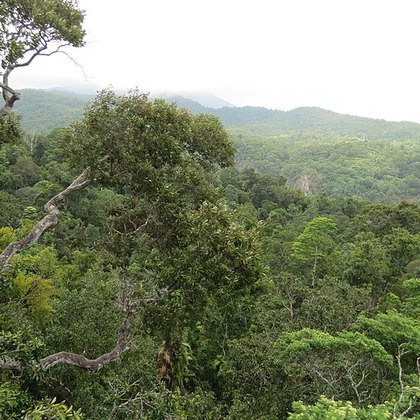
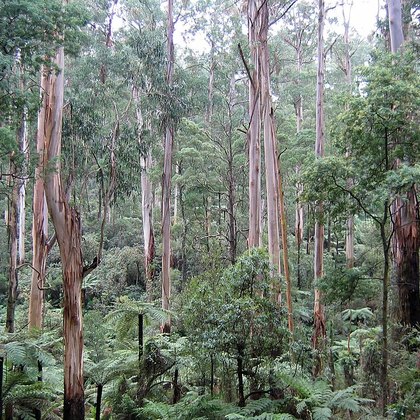
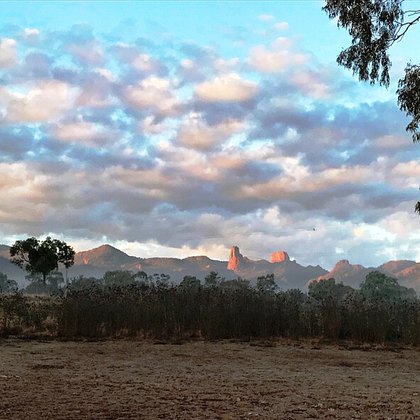
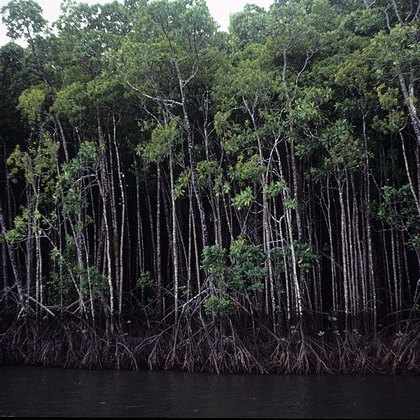
Tropical mountain and plateau rainforest and adjoining wet eucalypt forest, normally above three to four hundred metres. In winter birds drop to lower altitudes and then turn up in more open forest, in gardens around Cairns and even in mangroves. Nectar makes up the bulk of the diet, taken from flowering eucalypts, melaleucas and rainforest trees, with fruit and insects gleaned from foliage and bark. The nest is a suspended cup of bark, leaves and spider web, low to mid-height in a shrub or tree; breeding runs roughly from September to January.
Where the bird is most often found, arranged by main group and formation.
Range and movements
Endemic to Australia and confined to north-eastern Queensland: from the Bloomfield area and Cape Tribulation in the north, across the Atherton Tablelands, south to Mount Spec just north of Townsville. That is the heart of the Wet Tropics, a belt barely four hundred kilometres long. Within it the bird is locally numerous. Its movements are mainly vertical: in the cooler months birds shift to lower forest where something is in flower at the time, returning to the tablelands in spring. It does not occur in New Zealand.
- Resident
- dark = core range, pale = thinly spread
Where and when to look
Go to a flowering tree on the Atherton Tablelands — the Curtain Fig, Mount Hypipamee or the edge of Lake Eacham — and wait. Follow the noise: a squabbling party gives itself away. Then put the binoculars not on the wing but on the base of the bill: yellow against black still shows against the light and rules out Lewin's Honeyeater and the honeyeaters of the genus Meliphaga at once. If the bill is wholly black and you are not in the Wet Tropics but near Mackay, you have the Eungella Honeyeater in front of you.
Conservation
Least Concern (LC) and locally common within its small range; the population is regarded as stable and no threats have been demonstrated. The vulnerability lies in the nature of the country: the mountain rainforest of the Wet Tropics is small, sits like an island in drier land, and has nowhere higher to retreat to. A warmer climate shrinks the cool upland zone that species such as this depend on, and that is the main long-term question for every endemic of this forest.
Scientific name
Bolemoreus frenatus | (Ramsay, 1874)
Edward Pierson Ramsay described the species in 1874 as Ptilotis frenata; because it has since changed genus, author and year stand in parentheses. The genus Bolemoreus was erected only in 2011, after molecular work broke up the old catch-all genus Lichenostomus; the name is built from those of the Australian ornithologists Walter Boles and N. Wayne Longmore. The epithet frenatus is Latin for 'bridled', after the pale stripe that runs like a rein from the base of the bill across the cheek, and the English name says exactly the same. The Dutch name bontbekhoningeter chooses not the bridle but the two-coloured bill, which in the field is indeed the quicker feature. No subspecies are recognised.