All species › Tubenoses › Southern storm petrels › Black-bellied Storm-Petrel
Black-bellied Storm-Petrel | Fregetta tropica
Zwartbuikstormvogeltje | Paíño ventrinegro
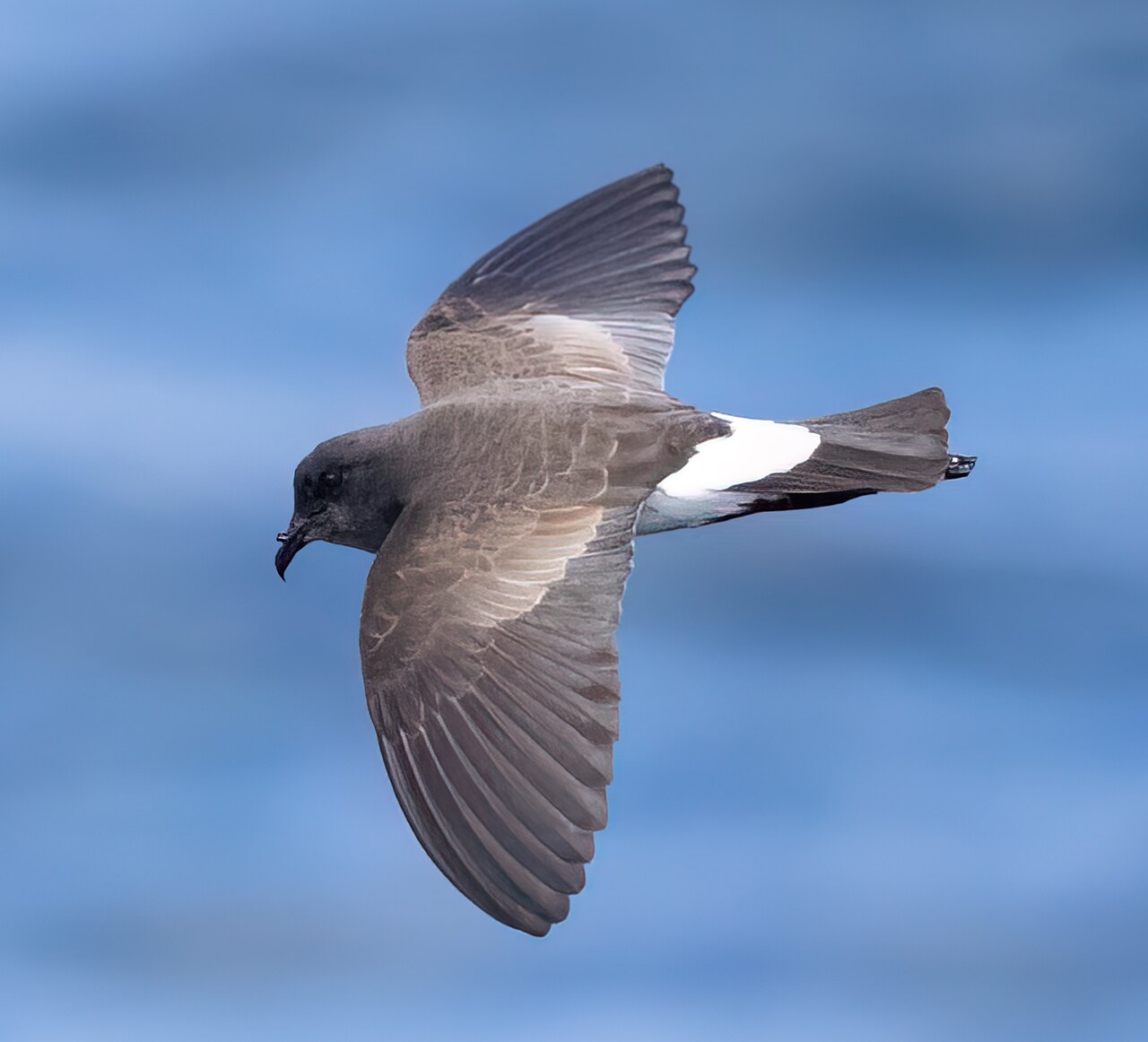
The Black-bellied Storm-Petrel is the most numerous black-and-white storm petrel of New Zealand's subantarctic waters: black head and breast, a broad white rump, white flanks and one black stripe running like a seam down the middle of the white belly. It flies low and erratically, striking the water with breast and feet at every swing, so that it seems to walk across the waves.
Voice
At sea it is silent. At the colony, which the birds reach only in darkness, those on the ground give a long drawn-out shrill whistle that breaks off and swells again, and a soft purring murmur comes from the burrows. From a boat you hear nothing; this is a species you see rather than hear.
Recording: Kevin Guille — CC BY-NC-SA 4.0 · Mayes island, France · xeno-canto
Identification
Twenty centimetres and fifty-five grams — the largest of the four Fregetta species here. Head, neck, breast and upperparts are black, with a broad white band across the rump. The belly is white with a broad black central stripe running from the breast to the base of the tail; the flanks stay white and the underwing is white with a dark margin. The legs are long and black, and in flight the feet clearly project beyond the tail tip — hold on to that, because it is the species' most reliable character. Flight is low, banking and irregular: it swings left and right, slapping breast and feet against the surface, so that it appears to step from wave to wave.
Confusion species
White-bellied Storm-Petrel (Fregetta grallaria) is the counterpart: slightly smaller, with an unmarked white belly and toes that just fail to project beyond the tail. The black belly stripe looks decisive but is not always: in some Black-bellied the stripe is narrow or broken, and birds of the Kermadec population of White-bellied sometimes do show dark on the belly. Use foot projection and flight action as second and third tests. New Zealand Storm-Petrel (Fregetta maoriana) and New Caledonian Storm-Petrel (Fregetta lineata) have no central stripe but rows of dark streaks over belly and flanks, and are smaller in build. Wilson's Storm-Petrel (Oceanites oceanicus) has a wholly dark underside and is considerably smaller; White-faced Storm-Petrel (Pelagodroma marina) has a white face with a black eye-mask.
Habitat
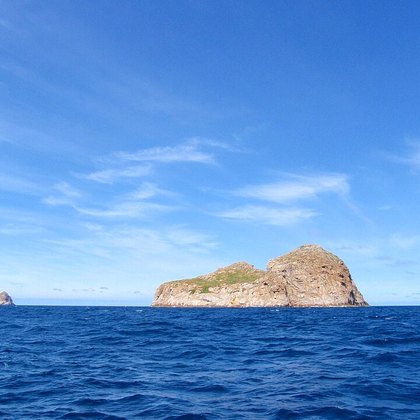
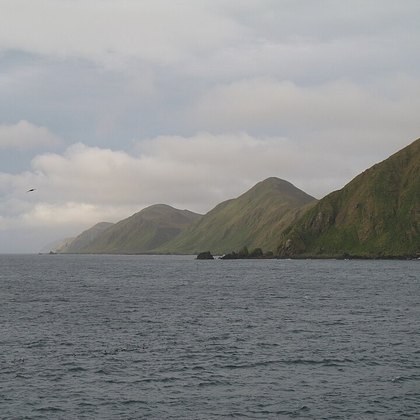
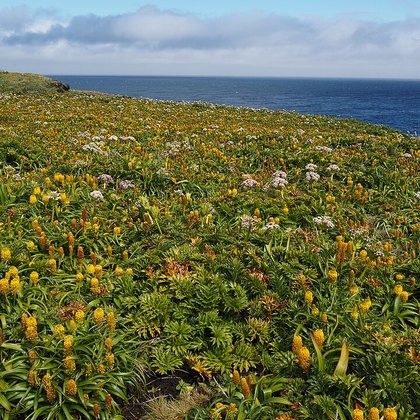
Cold to temperate water over and beyond the shelf edge, where it shears low over the surface snatching small crustaceans, squid and fish scraps. It breeds on subantarctic islands, in burrows and crevices under tussocks (clumps of tall, loose grasses; tussock: grassland of loose, tall clump-forming grasses, especially in New Zealand), among boulders and in soil beneath dense vegetation, on islands without rats, cats or pigs.
Where the bird is most often found, arranged by main group and formation.
Range and movements
Within this map window it breeds on New Zealand's subantarctic islands: the Antipodes and the Auckland group, where it occupies the predator-free outliers Adams, Rose and Enderby and not the main island, which carries cats and pigs. Outside the breeding season it moves north — away in May and June, back in October and November — into subtropical waters, so that through the southern winter it is seen regularly on pelagic trips off New South Wales, Victoria and Tasmania, and further north along the Australian east coast.
- Resident
- dark = core range, pale = thinly spread
Where and when to look
In New Zealand this is the Fregetta you meet first: take a trip out of Kaikoura or Stewart Island, or sail to the subantarctic islands. In Australia the pelagics out of Wollongong and Eaglehawk Neck in the cooler months are the best chance. Look at the tail tip the moment the bird turns away: if the feet stick out you have Black-bellied; only then go to the belly stripe, which disappears treacherously fast in poor light.
Conservation
Least Concern (LC), and listed in New Zealand as Not Threatened, with an estimated fifty to a hundred thousand pairs in the region. It does well because its breeding islands are largely predator-free or have been made so: the mice of the Antipodes were eradicated in 2016, and in the Auckland group it sits on the outliers that never carried cats or pigs. Where those animals are present — the main Auckland Island — it is absent. At sea, plastic in the diet and shifts in the food chain from warming water are the points to watch; bycatch barely touches a surface-picker of this size.
Scientific name
Fregetta tropica | (Gould, 1844)
Gould described the species in 1844; because it has since been placed in another genus, author and year stand in parentheses. Bonaparte introduced Fregetta in 1855, formed from Fregata, the frigatebird. The epithet tropica means 'of the tropics' and is misleading: it refers to the waters where the type was collected, not to the breeding range, since the bird in fact breeds on subantarctic islands and reaches warmer water only outside the breeding season. In Maori it is takahikare-rangi.