All species › Passerines › Woodswallows, bellmagpies and allies › Black-backed Butcherbird
Black-backed Butcherbird | Cracticus mentalis
Zwartrugorgelvogel | Verdugo dorsinegro
The Black-backed Butcherbird is the northern, smaller counterpart of the Pied Butcherbird: a black-and-white hunter of the open savanna woodland of Cape York and southern New Guinea. To see it in Australia means travelling far — it is one of the few songbirds the continent shares with New Guinea only at the tip of the peninsula.
Voice
A series of clear piping notes, round in tone but shorter and simpler in structure than the drawn-out song of the Pied Butcherbird, often given in duet by a pair. Alongside it come a rattling harsh alarm and a nasal yapping contact note within the family group. Song is heard most around sunrise and in the early wet season.
Recording: nick talbot — CC BY-NC-SA 4.0 · Artemis Station, Queensland, Australia · xeno-canto
Identification
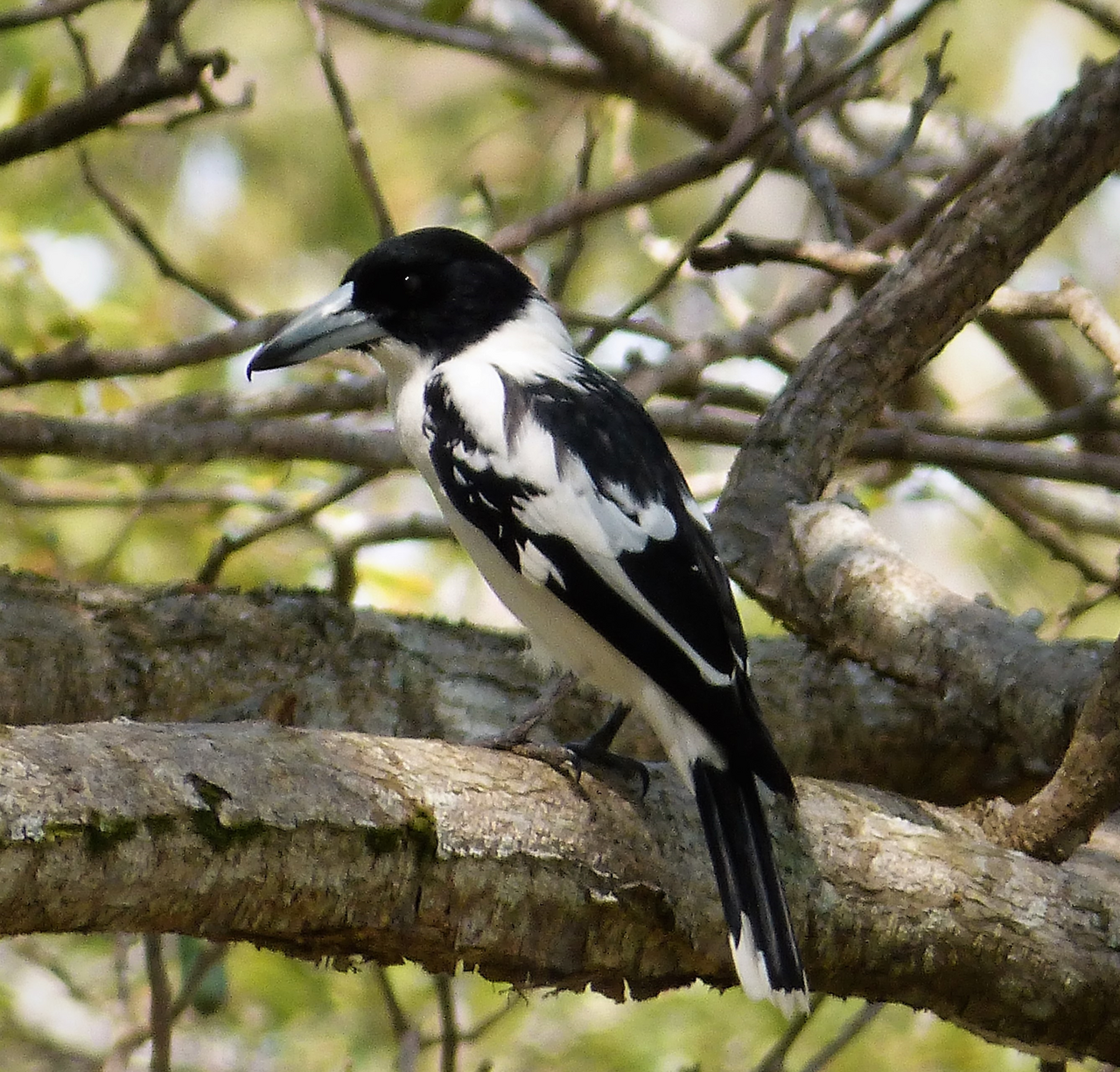
A butcherbird of about 26 to 28 centimetres, smaller and lighter than its southern relative. Head, mantle, wing and tail are black, with a white band in the wing and a white tail tip; a narrow white collar runs across the nape, dividing head from back. The underparts are white, with far less black on the throat than in the Pied Butcherbird. The bill is blue-grey with a black hooked tip.
Confusion species
Pied Butcherbird (Cracticus nigrogularis) is larger and heavier, with a broader white collar and a continuous black bib onto the breast; that throat pattern is the most reliable mark. Grey Butcherbird (C. torquatus) has a grey, not black, back. Black Butcherbird (Melloria quoyi) of mangrove and rainforest is wholly black with a heavy bill. Within the small Cape York range the place itself already helps: in Australia this species occurs nowhere off the peninsula.
Habitat
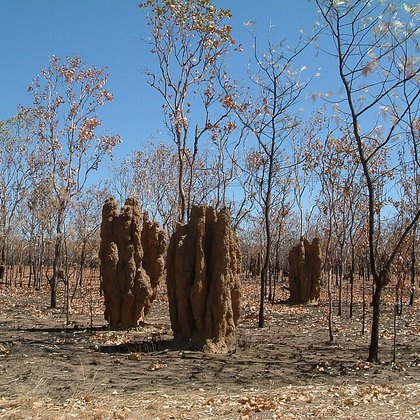
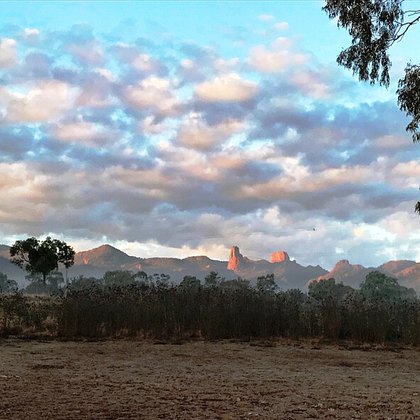
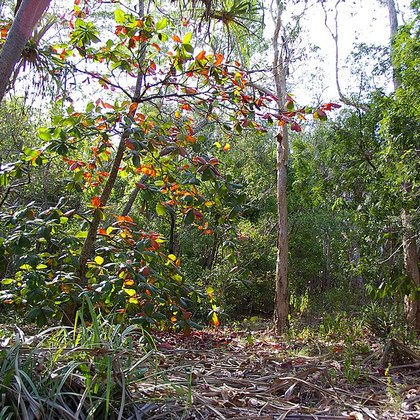
Open eucalypt and paperbark savanna, dry eucalypt forest and woodland with a grassy understorey, and the edges of monsoon forest and vine thicket. Like all butcherbirds it hunts insects, lizards and small birds from a perch. Closed rainforest and mangrove it leaves to Black Butcherbird.
Where the bird is most often found, arranged by main group and formation.
Range and movements
In Australia only Cape York Peninsula in the far north of Queensland; beyond that, southern New Guinea, with the type locality in its southeast. Sedentary, in pairs and small family groups on fixed territories. The Australian range is small, thinly peopled and poorly surveyed.
- Resident
- dark = core range, pale = thinly spread
Where and when to look
On Cape York, range is the first argument: every black-and-white butcherbird there deserves a second look. Check the throat — a narrow black chin patch instead of a broad bib — and the narrow white collar. Listen to the song: shorter and plainer than the long flute phrases of the Pied Butcherbird.
Conservation
Least Concern (LC). The range is small within Australia but large once New Guinea is counted, and the savanna woodland of Cape York is still largely intact. The species is little studied; almost nothing is known of numbers and trends in the Australian part, and changing fire management and grazing in the savanna are the factors to watch.
Scientific name
Cracticus mentalis | Salvadori & d'Albertis, 1876
Salvadori and d'Albertis described the species in 1876 from a bird taken at Nicura in southeastern New Guinea; author and year stand without parentheses, since the genus has not changed. Cracticus is from Greek kraktikos, 'noisy'; mentalis from Latin mentum, 'chin', for the black chin patch. The English and Dutch names both pick out the black back.