All species › Swifts › Swifts › Australian Swiftlet
Australian Swiftlet | Aerodramus terraereginae
Australische salangaan | Salangana australiana
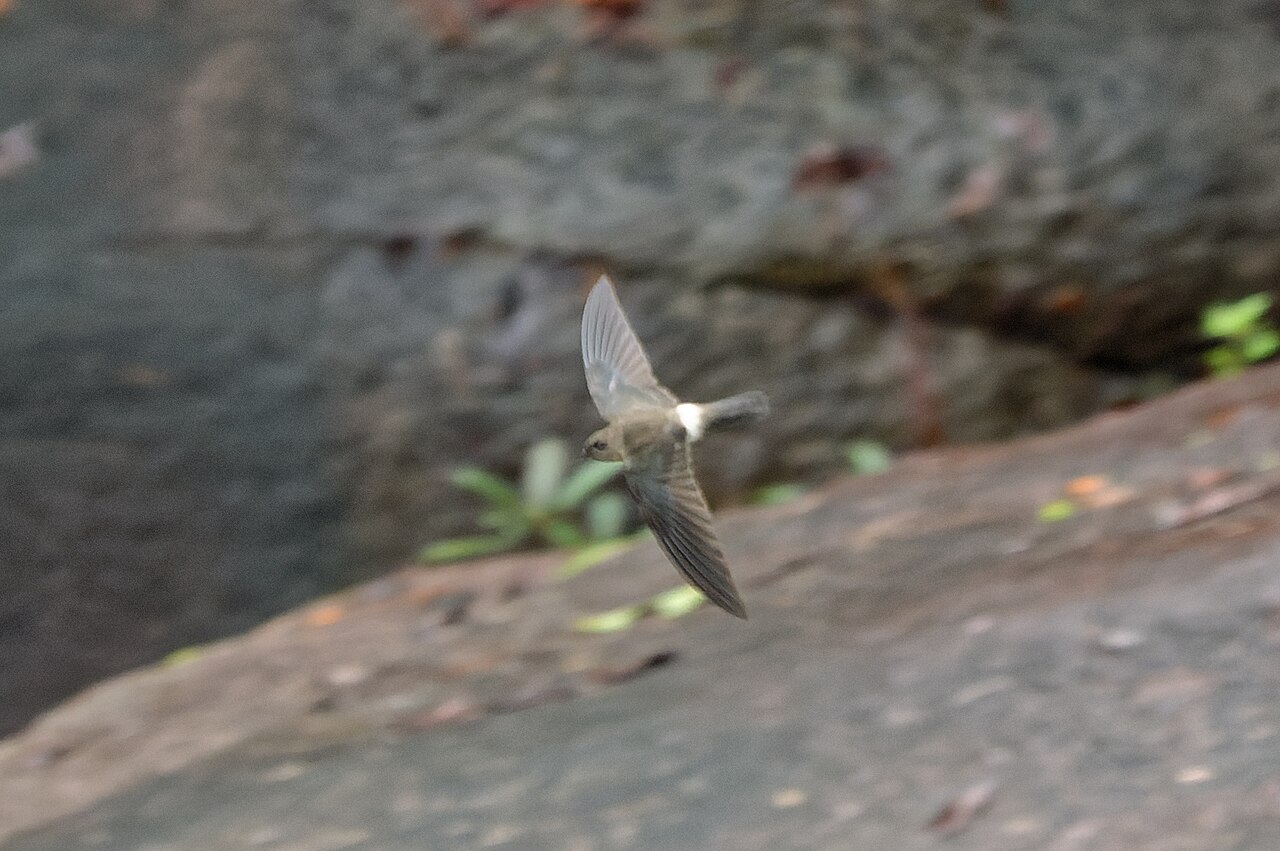
The Australian Swiftlet is the smallest swift in Australia and the only one that breeds in the country: an unobtrusive grey-brown bird of barely twelve centimetres that spends the day in the air over tropical Queensland and returns at night to caves and gorges. It belongs to the small group of birds that echolocate, and finds its nest in total darkness by ear.
Voice
In the air comes a thin, high twittering that hangs over a feeding flock like a fine rattle and is easily taken for insect noise. At the cave that sound changes: the moment the bird flies into the dark it starts to click — short metallic double clicks at frequencies between about one and ten kilohertz, low enough to be plainly audible to a human, unlike a bat's. With those clicks it measures the passage and picks out its own nest among hundreds of others. Around an occupied cave, morning and evening bring a continuous rattle of birds going in and out.
No recording with a suitable Creative Commons licence has been found for this species yet; what to listen for is described below.
Identification
A very small, compact swift of eleven to twelve centimetres with narrow scythe-shaped wings and a short, slightly notched tail that usually looks closed and blunt in flight. The upperparts are dark grey-brown, the forehead and head somewhat paler, and the underparts are plain grey without markings. The inland subspecies chillagoensis is smaller and paler. There is no white anywhere in the plumage — no rump band, no throat patch — and that complete plainness is the mark. The flight is flicking and jerky, with short glides, and far less stretched-out than that of the big swifts.
Confusion species
Fork-tailed Swift (Apus pacificus) and White-throated Needletail (Hirundapus caudacutus) are both one and a half to two times as long and three to nine times as heavy, and both show conspicuous white — a rump band on the first, a white horseshoe under the tail on the second. Fairy Martin (Petrochelidon ariel) and Tree Martin (Petrochelidon nigricans) are the real traps, being about as small: both have a pale rump and a much more fluttering, less knife-like flight, and the Fairy Martin a rusty head besides. Vagrant swiftlet species from New Guinea are scarcely separable with certainty away from a breeding cave; if the bird is not at a known colony, doubt remains justified.
Habitat
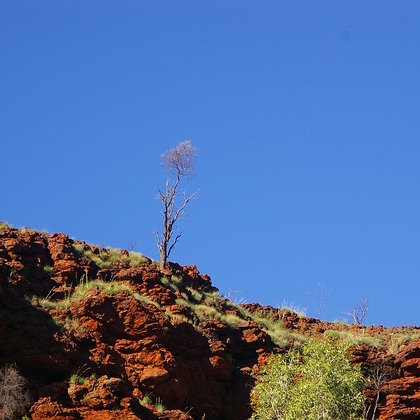
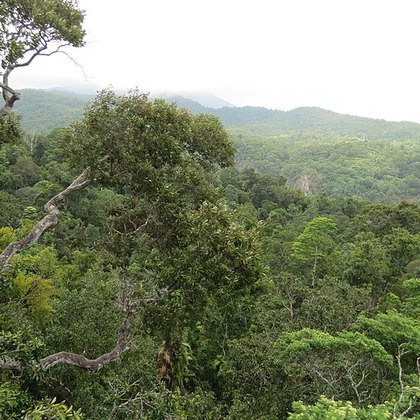
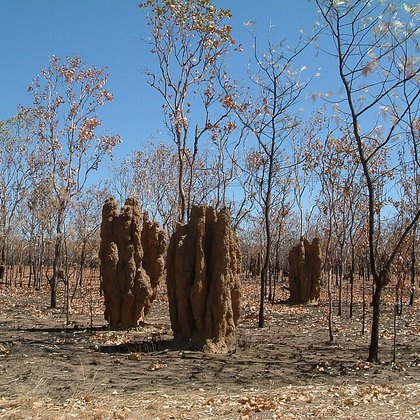
It breeds only in caves and deep gorges — limestone caves inland, granite gorges and sea caves on the coast — gluing its nest of saliva, grass, casuarina needles, twigs and feathers to the wall, two to twenty metres above the floor. It hunts in the air over anything within a day's reach, some thirty kilometres of the colony: rainforest edges, eucalypt savanna, pasture and grazing land, gorges and beaches, from sea level to about a thousand metres.
Where the bird is most often found, arranged by main group and formation.
Range and movements
Queensland only, from the Claudie River on Cape York south to the Eungella Range near Mackay, mainly in the coastal belt and the ranges behind it. The subspecies chillagoensis sits apart in the dry interior, in the limestone country of Chillagoe and in the Palmer and Mitchell districts. It is resident and stays at its colonies all year; it does not occur elsewhere in Australia, in Tasmania or in New Zealand. Nor does it live anywhere outside Australia: the species is endemic to Queensland.
- Resident
- dark = core range, pale = thinly spread
Where and when to look
Stand at the Chillagoe limestone caves or at a known coastal cave in the Wet Tropics late in the afternoon and wait for the return; the birds come in in dense streams and shoot through the entrance at great speed — observers have reported well over a hundred kilometres an hour. Anyone unable to reach a colony should look over a rainforest clearing or a cattle paddock near Cairns or Mission Beach, where they hunt all day. Watch the size and the absence of any white; that separates them from the martins they usually share the air with.
Conservation
Least Concern (LC): numbers are large and stable, although the whole range lies within one state. The vulnerability is not in the feeding grounds but in the breeding sites, since a species that nests in a few dozen caves and gorges loses a great deal when one colony is disturbed. Entry to caves in the breeding season, mining in limestone country and interest in edible swiftlet nests are the risks named; the nests of this species contain much plant material and are of little commercial value, which keeps that pressure limited.
Scientific name
Aerodramus terraereginae | (Ramsay, 1875)
Ramsay described the bird in 1875 as Cypselus terrae-reginae; because it was later moved to another genus, author and year stand in parentheses. The genus Aerodramus was introduced by Oberholser in 1906, from Greek aer, 'air', and dromos, 'racecourse' or 'runner'. terraereginae is Latin for 'of the queen's land' — Queensland, the state named after Queen Victoria and the only place the species occurs. The type locality is the north-east coast ranges near Cardwell, Queensland. For a long time the bird was treated as a subspecies of the White-rumped Swiftlet (Aerodramus spodiopygius).