All species › Passerines › White-eyes and allies › Ashy-bellied White-Eye
Ashy-bellied White-Eye | Zosterops citrinella
Citroenbrilvogel | Anteojitos pálido
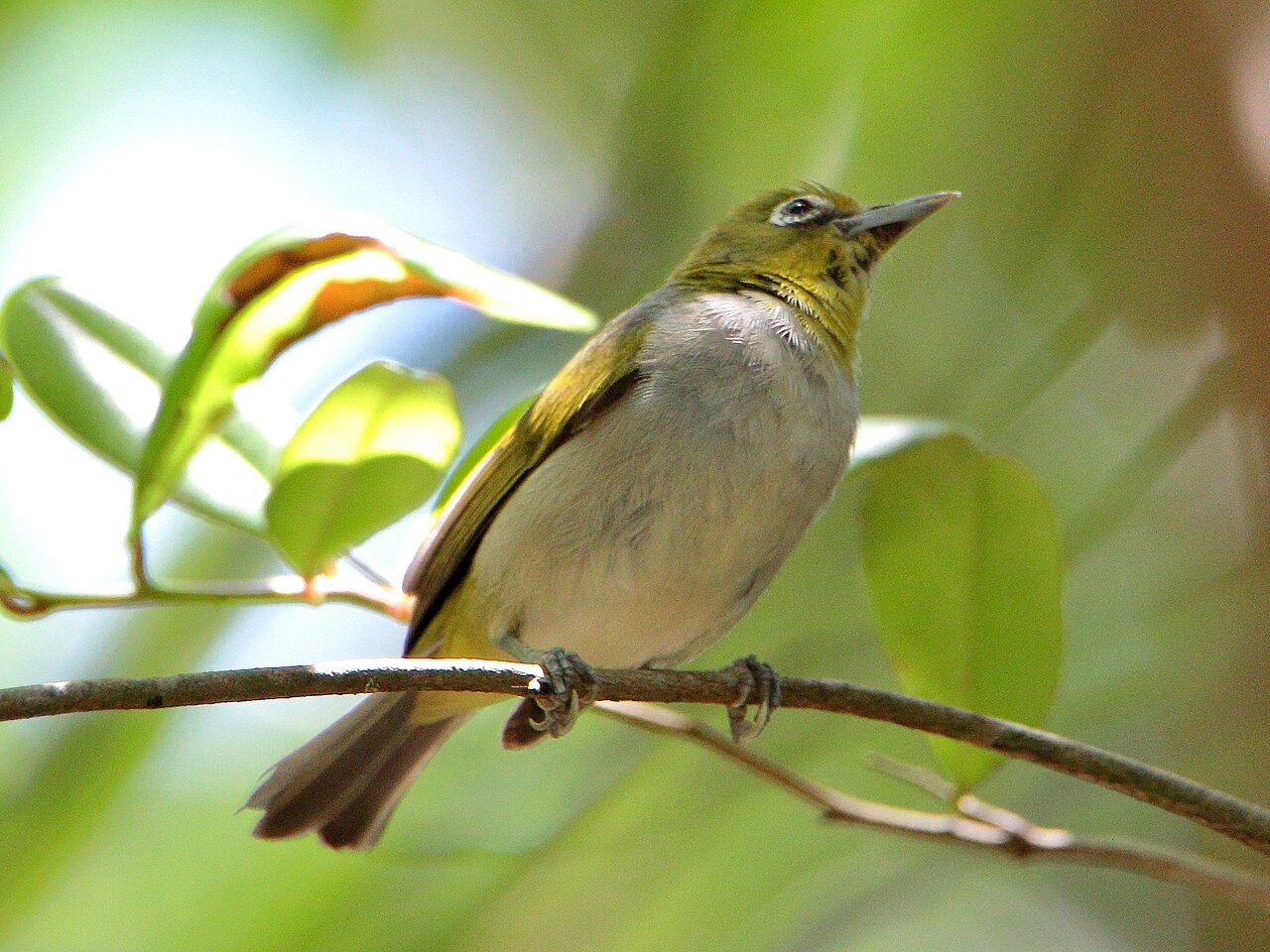
The Ashy-bellied White-Eye is the white-eye of the islands. In Australia it is not a mainland bird at all but one of the small islands of Torres Strait and the coral cays of the Great Barrier Reef, south to Lizard and Heron Island, with a foothold on the far north of Cape York. It is a small green bird with a white eye-ring and a strikingly pale belly, moving through mangrove and vine thicket in small, busily calling parties.
Voice
The contact note is a thin, faintly nasal tsee that ties a party together and is usually the first sign of the species; it runs on for as long as the group works through the canopy. The song is a hurried high twitter with no set structure, soft and easily lost under the sound of the surf on a coral cay. Alarmed birds switch as one to a sharp, rattling scold.
Recording: Mike Nelson — CC BY-NC-SA 4.0 · Damar Island, Southwest Maluku, Indonesia · xeno-canto
Identification
A bird of ten to eleven centimetres, olive-green on crown, back and wing, with a sharply drawn ring of short white feathers around the eye. Throat and undertail coverts are yellow, but breast and belly are white to dirty grey, and that pale centre is what fixes the species. The bill is fine, pointed and dark, the legs grey. The sexes are alike; young birds have a narrower, duller eye-ring and a paler yellow throat. Reef island birds are whiter below than those of the Lesser Sundas.
Confusion species
Silvereye (Zosterops lateralis) is where it goes wrong: it has a grey back between green head and wing, and buff to chestnut flanks instead of a white centre. It is abundant on the mainland and reaches the larger reef islands too. Canary White-Eye (Zosterops luteus) of the north and west coast is yellow throughout and has no pale belly. On the Torres Strait islands it pays to look at the flank first: no brown means Ashy-bellied.
Habitat
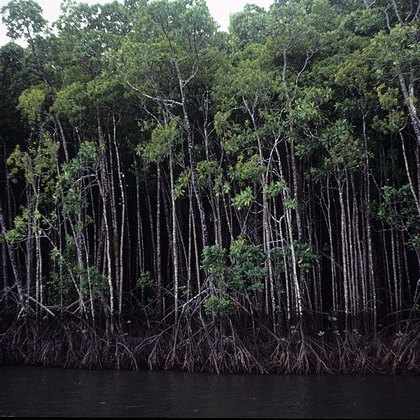
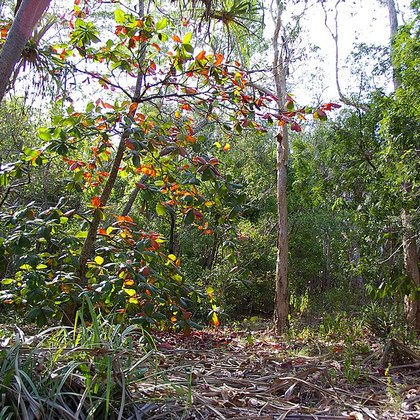
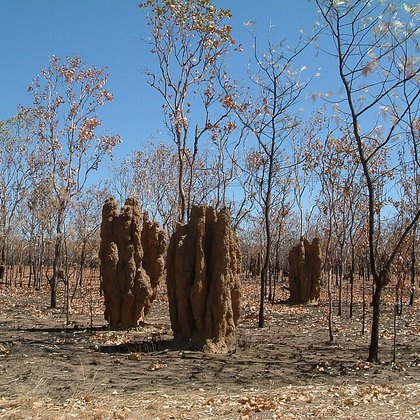
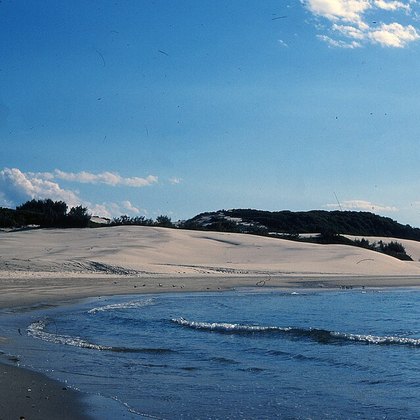
Mangrove along island creeks and shores, and the closed heads of monsoon forest and vine thicket that grow on the sand ridges of the cays: pisonia, casuarina and tournefortia. On Cape York it also uses eucalypt savanna where trees are in flower. The bird stays low and close to foliage and rarely crosses more than a few hundred metres of open water.
Where the bird is most often found, arranged by main group and formation.
Range and movements
The centre of the species lies outside this region, in the Lesser Sundas and on the Tanimbar Islands. In Australasia the bird is the subspecies albiventris, which holds the small islands of Torres Strait and from there runs south along the reef islands to Lizard Island and the Heron group; on the mainland it is confined to northern Cape York. It does not migrate but does move between neighbouring islands.
- Resident
- dark = core range, pale = thinly spread
Where and when to look
Walk the edge of the pisonia forest on a coral cay in the first hour after sunrise and listen for the thin contact note; the party gives itself away before it shows. Stand still when the birds come to a flowering tournefortia, where they hang out in the open. Check flank and back on every white-eye on the reef islands, because Silvereye is there in winter as well.
Conservation
Least Concern (LC). The species as a whole has a large range and stable numbers; the Australian birds are only a small part of it and have never been counted. The risks here are the ones island birds face: cyclones that strip the scrub off a cay (low sand islet on a coral reef), rats coming ashore, and tourist development on the inhabited reef islands. On most of the islets it holds, none of that is happening.
Scientific name
Zosterops citrinella | Bonaparte, 1850
Bonaparte described the bird in 1850 already in the genus Zosterops, so author and year carry no parentheses. The genus was introduced by Vigors and Horsfield in 1827, from Greek zoster, 'girdle', and ops, 'eye': the white ring around the eye. citrinella is the diminutive of medieval Latin citrinus, 'lemon-yellow', after the yellow throat. The type locality lies in the Lesser Sundas; the Australian birds belong to the subspecies albiventris, 'white-bellied'.